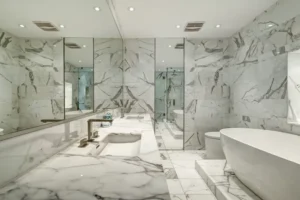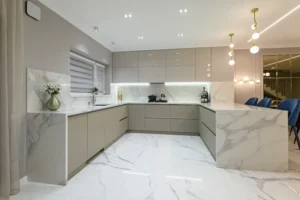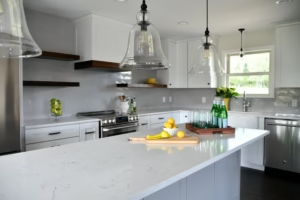
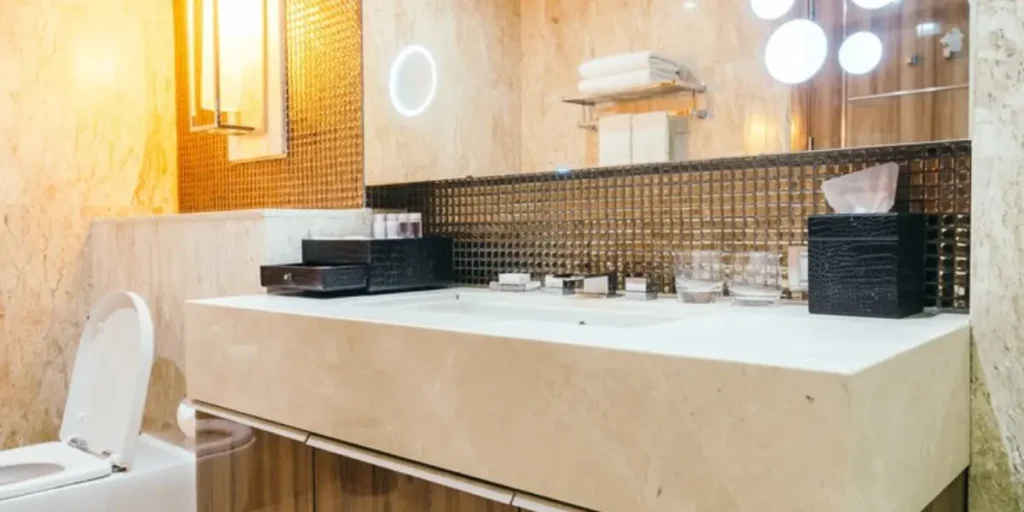
White quartz works especially well in small, dark, or traditional bathrooms because it reflects light and creates a clean visual base. A white vanity top can also make cabinets, tile, mirrors, and hardware easier to match.
The right white matters. Pure white may feel sharp in a bathroom with warm beige flooring. Creamy white may look yellow next to cool gray tile. A slab with soft gray veining can connect the countertop to brushed nickel or chrome fixtures.
Popular directions include:
- Solid bright white quartz for a simple look
- Soft white quartz with fine gray veining
- Marble-look quartz with larger veins
- Warm white or cream quartz for traditional bathrooms
- White quartz with subtle movement for larger vanities
Look at the full slab before making a final choice. A small sample can hide how bold or quiet the veining appears across a six-foot vanity.
Quartz Bathroom Countertops with Sink
Quartz countertops can be paired with undermount, drop-in, or vessel sinks, but undermount sinks are often the easiest to clean because the countertop has no raised rim around the sink opening. The best sink style depends on vanity height, countertop thickness, faucet placement, and how the bathroom will be used.
An undermount sink creates a clean edge between the sink and the quartz. Water can be wiped directly into the basin, which reduces the need to clean around a raised lip. This setup is popular for both modern and traditional bathrooms.
A drop-in sink has a visible rim that rests on the countertop. It can work well for replacement projects and may fit certain existing vanity designs. The rim, however, creates an extra area where soap residue can collect.
Vessel sinks sit above the countertop. They make a strong design statement, but the final vanity height needs careful planning. A standard cabinet plus a tall vessel sink can become uncomfortable for shorter users or anyone who needs to sit while using the vanity.
Why Choose Quartz Countertops for Your Bathroom?
Beyond aesthetics, quartzite countertops bathroom possesses desirable traits driving its popularity for bathrooms.
Choosing quartz bathroom countertops provides an ideal balance of safety, longevity, and effortless maintenance for any home environment. Manufactured by blending natural stone crystals with resin binders, these surfaces form a solid barrier that repels water, soap scum, and daily spills.
Traditional stone options like marble or granite are naturally porous, meaning they absorb moisture, harbour bacteria, and require routine chemical sealants to prevent permanent staining. Engineered stone stays completely sealed from the day it’s installed.
For households focused on simple care, this non-porous structure is a massive win. Mold and mildew cannot take root in the surface, keeping hygiene high with minimal effort. Scrubbing on hands and knees or using aggressive chemical cleaners becomes a thing of the past. Warm water and a soft rag wipe away toothpaste, liquid soap, and cosmetics in seconds.
Dropping heavy toiletries, metal grooming tools, or medical equipment can easily chip softer materials. Engineered quartz offers high flexural strength that withstands accidental impacts without cracking or scratching. It holds up reliably through years of daily routines.
Showroom and Product Options
Visiting a local kitchen and bath showroom lets you touch and evaluate different surface finishes in person before making a buying decision. Testing finishes under real lighting conditions helps you find a surface that matches your functional requirements.
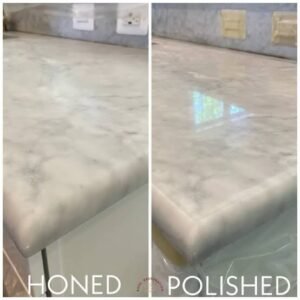
Polished Finish: Smooth, highly reflective, and extremely easy to wipe down. Highly recommended for simple daily cleaning.
Honed or Matte Finish: Smooth with a soft, non-reflective appearance. Great for reducing glare under bright lights, though it may show thumbprints slightly more than polished tops.
Textured or Leathered Finish: Features subtle surface texture that adds tactile grip, making it easier to feel objects on the counter.
When reviewing physical slabs, bring samples of your cabinet finishes and wall paint to verify contrast levels. Testing how a damp rag slides across different finishes helps you pick the most comfortable option for daily care routines.
Installing Quartz Countertops in Your Bathroom
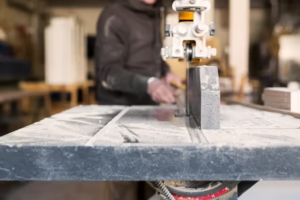
Professional installation ensures your heavy quartz slab receives structural support, level seams, and waterproof edge sealing. Engineered stone slabs are exceptionally dense and heavy. Standard bathroom vanities often require internal bracing before accepting a thick stone top.
Technicians measure the room using digital lasers to map wall irregularities. Once cut, the slab is set in place using specialized suction equipment. Installers secure the top with high-strength silicone along the cabinet frames and apply color-matched epoxy at any necessary seam locations.
Attempting a DIY installation with heavy stone creates safety hazards and risks cracking the slab if the underlying cabinet isn’t level. Professional crews handle the heavy lifting and complete the job cleanly in a few hours.
Quartz Bathroom Countertops vs. Marble and Quartz
The right material depends on maintenance needs, appearance, budget, and how the bathroom is used. No surface wins in every situation.
Quartz vs. Marble
Marble is a natural stone with natural variation. Many homeowners choose it for its depth and veining.
Quartz offers a marble-inspired look with lower routine maintenance. Marble can stain or etch when exposed to acidic products and may require periodic sealing. Quartz does not usually need that same sealing routine.
The trade-off is authenticity. A marble-look quartz surface can imitate the appearance of marble, but natural marble has geological movement that cannot be exactly repeated.
Choose marble when natural variation and character matter more than low maintenance. Choose quartz when daily practicality carries more weight.
Quartz Vanity Tops
Our bathroom vanity with quartz countertop installed beautifully. Double/single hole cutouts for faucets or sinks integrate seamlessly. Choose from sleek polished edges or decorative profiles handcrafted by our fabricators.
Simple Care Guidelines for Long-Term Durability
Maintaining engineered stone requires no special skills or costly products. Following a few basic habits keeps the surface looking brand new while preserving a healthy indoor environment.
Daily Wipe Down: Use warm water, mild liquid dish soap, and a soft microfiber cloth to clean off toothpaste, water spots, and dust.
Avoid Harsh Chemicals: Skip bleach, oven cleaners, drain openers, and abrasive scouring pads. Strong acids or high-pH chemicals break down the resin binders over time.
Protect from Direct Heat: Avoid placing hot styling irons or curling tongs directly on the stone deck. Use silicone heat pads to prevent thermal shock marks.
Clear Dried Spills Softly: If hair dye or liquid soap dries on the counter, soak the spot with a damp rag for five minutes, then gently scrape it off with a plastic putty knife.
Free Shipping
We provide free standard shipping within business days on all quartz, granite, marble, and other natural stone orders. After carefully packing each slab for safe transport and delivery, they arrive ready for installation. Please reach out anytime at 978-459-582 with any project needs!
Conclusion
Quartz bathroom countertops offer many styles that can beautifully enhance a modern bathroom redesign. From solid whites and grays to veined options, there is a quartz to suit any palette. Working with a professional fabricator ensures an on-trend quartz selection and flawless installation.
SF Marble and Granite strives to provide top-quality quartz, granite and stone products for all projects. Their experienced team can turn any vision into reality. Contact us at 978-459-582 or visit their showroom at 755 Dutton St. Lowell- 0185MA4 to discuss transforming your bathroom into a spa-like retreat. Our workmanship and customer service will delight from start to finish.
FAQs
Do quartz countertops require regular sealing?
No, engineered stone surfaces never require sealing. The manufacturing process bonds stone particles with resin binders, creating a solid, non-porous structure that repels liquids without chemical sealers.
Is quartz hygienic enough for personal care spaces?
Yes, engineered stone is one of the most hygienic surfacing materials available. Because it lacks microscopic pores, bacteria, viruses, mold, and mildew cannot penetrate or grow inside the slab.
Can hot curling irons damage the surface?
Yes, high heat can damage resin binders, leaving discolored rings or hairline cracks. Always place hot styling tools or heating pads on protective silicone mats.
How do I remove stubborn toothpaste or makeup spots?
Soak the dried spot with warm water and mild dish soap for a few minutes to soften it. Wipe away with a soft cloth, or use a flexible plastic scraper for sticky residue. Avoid abrasive scrub pads.