You typed “marble floors cost” into Google because you want a real number, not a sales pitch. Fair enough. Shopping for natural stone feels a lot like walking into a jewelry store with no price tags on anything. Here’s the quick answer: most homeowners pay between $9 and $75 per square foot installed, depending on the type of marble, the tile size, and how complicated the layout is. Premium slabs run higher than that.
This article breaks that number down room by room, so you know what a bathroom, kitchen, or full first floor actually costs before you call a contractor. We’ll cover what pushes the price up, how installation actually works, and how marble stacks up against porcelain, granite, and quartz. By the end, you’ll have a realistic budget and a list of questions worth asking before you sign anything.
Marble Flooring Cost Per Square Foot Breakdown
Marble tile material alone usually runs $5 to $60 per square foot, and installation labor adds another $4 to $15 per square foot on top of that. Put the two together and most homeowners land somewhere between $9 and $75 per square foot installed. Premium slabs, the kind used for bookmatched entryways or statement showers, can climb to $100 to $200 per square foot once labor, waste, and edge finishing are added in.
Here’s a rough breakdown by grade:
| Marble Grade | Material Cost (per sq ft) | Installed Cost (per sq ft) |
|---|---|---|
| Standard or commercial grade | $5 – $15 | $9 – $25 |
| Mid-range (Carrara, Botticino) | $15 – $30 | $25 – $45 |
| Premium (Calacatta, Statuario) | $40 – $100+ | $70 – $200+ |
Two things move the price inside each of those bands: the size of the tile and the finish. A 12×12 tile in a polished finish is the cheapest way to get real marble on your floor. Large-format slabs, honed surfaces, and leathered textures all add cost, partly because they need more careful handling and partly because there’s simply less waste tolerance when you’re working with bigger pieces.
Marble Slabs vs Marble Tiles
This is a distinction most homeowners miss. Tiles are cut pieces, typically 12×12 or 24×24, affordable and practical for most floors. Slabs are large uncut pieces of stone, used for high-end continuous floors with no tile lines. Basic slabs start at $10 to $20 per square foot for material. Premium options like large-format Calacatta or onyx slabs can exceed $60 per square foot before installation.
For most home projects, tiles are the right call. Slabs are reserved for luxury installs where matching veining across a large surface is part of the design intent.
Do not forget these add-on costs. Subfloor preparation adds $1 to $5 per square foot depending on condition. Underlayment runs $0.50 to $2. Grout and sealer add another $0.50 to $1.50. Removing old flooring costs $1 to $3. Pattern cuts like herringbone or diagonal add $3 to $8 more per square foot.
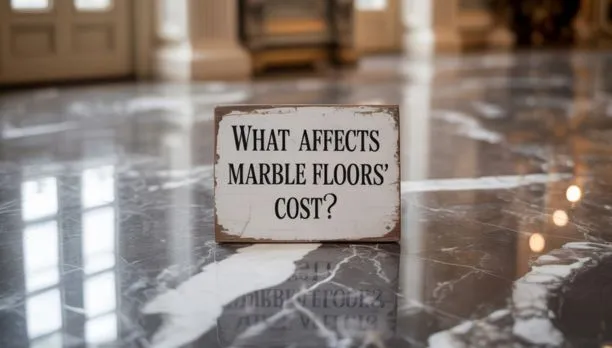
What Affects Marble Floors Cost?
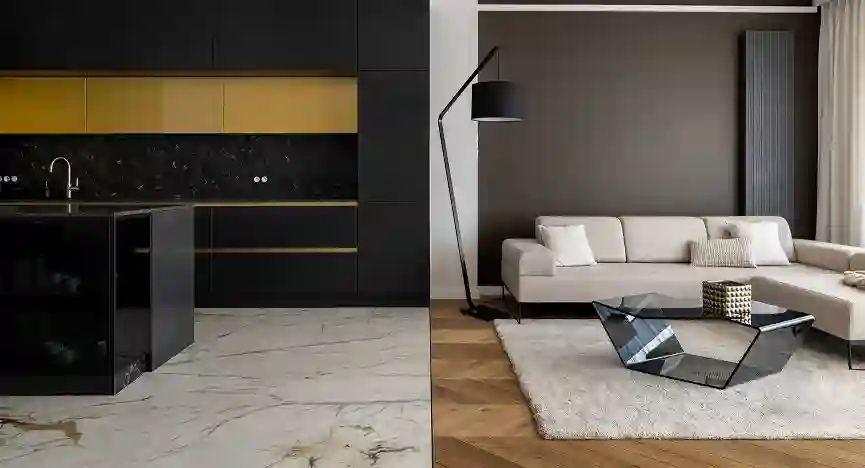
Several physical and geographical factors directly influence your final contract pricing.
Material Sourcing, Rarity, and Veining
How much does stone rarity affect total project expenses? Rare natural stone varieties cost significantly more due to limited quarry supply and high global demand. Marbles with striking, bold veining and pure white backgrounds command top-tier pricing, whereas stones with frequent geological inclusions or muted, inconsistent patterns sit at more accessible price points.
Quarrying processes dictate availability. Mined stones like Italian Statuario or Calacatta Gold come from restricted mountain regions in Carrara, Italy. Domestic or widely quarried varieties like Indian White Sangemarmar or Georgia White stay far more budget-friendly.
Surface Finishes and Edge Profiles
Surface treatments alter both price tags and daily performance:
Polished Finish: Features a glossy, reflective surface. Polishing requires additional diamond pad buffing cycles, adding $1 to $3 per square foot.
Honed Finish: Offers a smooth, velvety matte surface. It hides surface scratches better than polished stone and provides superior slip resistance for aging family members.
Leathered or Tumbled Finish: Creates a textured, rustic feel that resists moisture. Extra processing steps raise production costs by $2 to $5 per square foot.
Tile Dimensions and Custom Slabs
Standard 12×12-inch or 12×24-inch floor tiles are affordable to package and ship. Large-format tiles (such as 24×24 inches or larger) and continuous floor slabs cost substantially more. Extracting massive, uncracked stone blocks from quarries requires specialized equipment, driving up material waste and transit fees.
Subfloor Condition
Marble does not flex. If your subfloor has soft spots, uneven sections, or moisture problems, every one of those issues causes cracking after installation. A good installer checks the subfloor before quoting. If it needs work, budget $1 to $5 per square foot to level and reinforce it before tile goes down.
You can read about: Most Expensive Marble in the World
Room Size Cost Examples: Budget vs Custom
Real-world project pricing depends directly on square footage. The examples below highlight typical costs for standard residential rooms using mid-range Carrara or Crema Marfil tiles.
Small Powder Room or Bathroom (50 sq. ft.):
Material (at $10/sq. ft.): $500
Labor & Supplies (at $8/sq. ft.): $400
Total Estimated Cost: $900 – $1,400
Main Living Room or Open Kitchen (300 sq. ft.):
Material (at $15/sq. ft.): $4,500
Labor & Supplies (at $10/sq. ft.): $3,000
Total Estimated Cost: $7,500 – $10,500
Large Formal Living Area or Whole-Floor Build (800 sq. ft.):
Material (at $22/sq. ft.): $17,600
Labor, Subfloor Reinforcement & Supplies (at $12/sq. ft.): $9,600
Total Estimated Cost: $27,200 – $36,000
Marble Floor Installation Process
Understanding the steps helps you understand why the labor costs what it does.
Step 1: Site Assessment
A skilled installer checks your subfloor before touching anything. They test for level, moisture, and load-bearing strength. Marble is heavy. Weak subfloors crack marble. This step separates experienced installers from cheap ones.
Step 2: Subfloor Preparation
This includes leveling compounds, moisture barriers, and cement backer board. Budget $1 to $5 per square foot. It is not glamorous, but skipping it is the single most common cause of marble floor failure.
Step 3: Layout Planning
The installer dry-lays the tiles first. No adhesive yet. This plans the pattern, the centering, and where cuts fall. For herringbone and diagonal patterns, this stage is critical to a clean final result.
Step 4: Mortar Application
Polymer-modified thinset mortar is applied with a notched trowel. The coverage must be even. Hollow spots under marble areas where mortar did not fully bond create stress points that crack over time.
Step 5: Tile Setting
Tiles go down firmly into the mortar. Spacers keep grout lines consistent. A level is checked constantly. Heavier tiles need back-buttering, which means mortar on both the floor and the back of the tile.
Step 6: Grouting
After mortar cures usually 24 to 48 hours grout goes in. Unsanded grout is best for tight 1/16 inch joints common in marble work. Sanded grout suits wider spacing. Grout color choice affects the entire look of the finished floor.
Step 7: Sealing
Marble is porous. Without a penetrating sealer, wine, coffee, lemon juice, and even water leave permanent stains. A quality sealer goes on after grouting. Plan to reseal every one to three years depending on foot traffic.
Total timeline for most rooms: three to seven days including drying time.
Beautiful Marble Floor Designs
Floor design choices shape room ambiance while directly affecting your installation labor quote.
Timeless Layout Patterns
Straight Grid: The simplest, most cost-effective installation method. Aligned grid layouts create clean lines with minimal tile waste (typically 5% to 8% extra material needed).
Diagonal or Diamond: Angles tiles at 45 degrees to make small rooms feel larger. Requires precise perimeter cuts, increasing material waste to 15%.
Herringbone and Chevron: Intricate V-shaped patterns that add architectural sophistication. Crafting these layouts demands extensive cutting skills, raising labor costs by up to 30%.
Inlaid Patterns and Decorative Borders
Inlaid floor borders mix contrasting stone colors like Nero Marquina black with white Calacatta stone. Custom waterjet-cut inlays and intricate medallions require expert hand placement, with specialized custom labor running anywhere from $50 to $150 per square hour.
Using a Marble Flooring Cost Calculator
A marble flooring cost calculator is a practical first step before calling any contractor. It gives you a ballpark number based on your room size and stone choice. Here is how to calculate marble price yourself.
Step 1: Measure your room. Length times width equals total square footage. Example: 15 feet by 12 feet equals 180 square feet.
Step 2: Add waste. Standard rooms get 10 percent. Diagonal or pattern layouts get 15 percent. 180 square feet times 1.10 equals 198 round to 200 square feet.
Step 3: Multiply by material cost. 200 square feet at $10 per square foot for Carrara equals $2,000.
Step 4: Add labor. 200 square feet at $12 per square foot equals $2,400.
Step 5: Add extras. Subfloor prep, sealer, grout, and old floor removal typically add $500 to $1,500.
Total estimate for 180 square feet in Carrara: $4,900 to $5,900.
This marble price calculator method gives you a solid working number. Online marble cost calculators work the same way but use regional averages, which may not match your local labor rate. Always run the numbers yourself first, then compare to quotes.
How Marble Floors Compare to Other Flooring Options
Choosing floor materials requires weighing upfront installation expenses against long-term durability and daily maintenance demands.
| Flooring Material | Average Installed Cost (Per Sq. Ft.) | Durability & Lifespan | Maintenance Level | Moisture & Stain Resistance |
| Natural Marble | $10 – $40+ | 50+ Years (Lifetime) | Moderate to High | Low (Requires regular sealing) |
| Marble-Look Porcelain Tile | $8 – $18 | 30 – 50 Years | Low | High (Impervious to water) |
| Quartzite / Natural Granite | $12 – $35 | 50+ Years | Moderate | Moderate to High |
| Hardwood Flooring | $8 – $22 | 20 – 30 Years | Moderate | Low (Vulnerable to water) |
| Luxury Vinyl Plank (LVP) | $4 – $9 | 10 – 20 Years | Very Low | High (100% Waterproof) |
Real Marble vs. Marble-Look Porcelain
While genuine stone offers unmatched natural depth, high-end glazed porcelain tiles replicate marble veining effectively at a lower price point. Porcelain requires no sealing, handles heavy spills effortlessly, and reduces installation labor costs due to lighter handling requirements.
Marble Flooring Maintenance Costs
The upfront marble floors cost is only part of the budget. Factor in what you will spend over time.
Annual sealing costs $0.50 to $1.50 per square foot if you hire a professional. A DIY bottle of penetrating sealer runs $15 to $50 and covers around 200 to 400 square feet. The water test tells you when it is time to reseal: drop water on the surface and watch it. If water beads up, you are fine. If it soaks in within a few minutes, reseal.
Professional deep cleaning runs $0.75 to $2.50 per square foot and is recommended every two to three years for high-traffic floors.
Polishing and honing cost $1 to $4 per square foot when the surface starts to dull or show fine scratches. Polishing restores the glossy finish. Honing creates a matte surface that hides scratches better.
Chip or crack repair runs $100 to $300 per repair depending on severity.
Over ten years, budget an additional $2 to $8 per square foot in maintenance. On a 200 square foot kitchen, that is $400 to $1,600 spread across a decade a manageable number for a floor that lasts 50 years or more when properly cared for.
Transform Your Home with Expert Marble Floor Installation
Planning and execution are two different things. You can have perfect numbers on paper and still end up with a floor that cracks, chips, or looks uneven because the installer cut corners on subfloor prep or skipped proper sealing.
If you are in Massachusetts and ready to move forward, working with a local specialist who has handled everything from small bathroom floors to full-home marble installations makes the difference between a floor that disappoints and one that lasts decades.
SF Marble & Granite has been handling marble and stone installations across the Lowell, Lawrence, and North Andover areas for years. The team manages every step in-house from subfloor inspection and pattern planning to final sealing. No subcontracting, no surprise bills after the fact.
For homeowners specifically looking for Marble Floor Installation in Lowell, MA, the team at SF Marble & Granite offers upfront pricing, high-quality stone sourcing, and workmanship that holds up. Getting a professional estimate is the smartest first step. A skilled installer will catch problems you cannot see and give you a real number, not a guess.
Final Thought
Marble floors are a long-term investment. They look beautiful, hold their value, and outlast most other flooring options when properly maintained. The key is going in with realistic numbers.
Marble floors cost $13–$50+ per square foot installed, with most homeowners landing somewhere in the $20–$35 range for mid-grade marble. Use the step-by-step calculation method in this guide, get multiple contractor quotes, and budget 10–15% extra for surprises.
Whether you use a marble price calculator online or crunch the numbers manually, knowing the full cost picture puts you in control. Pick the right stone, find a skilled installer, and your marble floor will look incredible for decades.
FAQs
What is the average marble flooring cost for a bathroom?
A mid-size bathroom at 80 to 120 square feet costs $2,500 to $8,000 installed depending on marble type and layout. Budget marble starts around $1,500. Premium installs with Calacatta and custom patterns can reach $12,000.
Is marble flooring worth the cost?
Yes, for the right situation. Marble adds genuine resale value, lasts decades, and looks better than any synthetic material can replicate. It performs best in lower-traffic areas away from constant acidic exposure.
How do I use a marble cost calculator?
Measure your room, add 10 to 15 percent waste, multiply by material cost, add labor at $8 to $20 per square foot, then add $500 to $1,500 for supplies and subfloor prep. Many online marble flooring cost calculators automate this but use averages always verify with local contractor quotes.
Can I install marble floors myself?
Not recommended. Marble is heavy, brittle, and unforgiving of any error in leveling or mortar coverage. Improper installation causes hollow spots, cracking, and grout failure. The labor cost is worth it for a floor that lasts.
How often does marble flooring need to be resealed?
Every one to three years depending on foot traffic. The water bead test is the most reliable indicator. If water soaks in rather than beading on the surface, it is time to reseal.