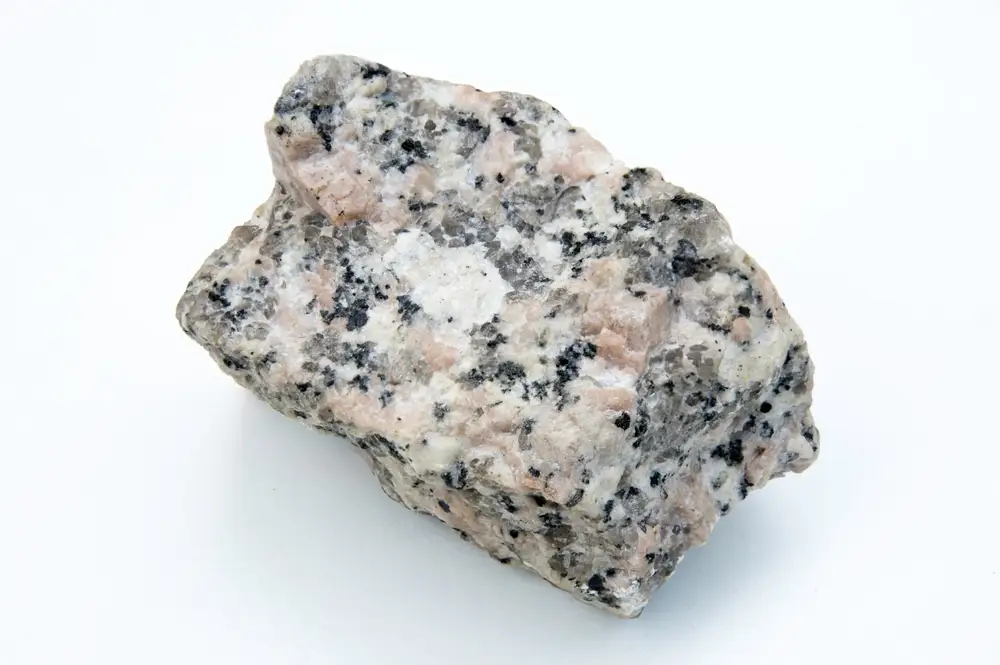
Granite is one of the hardest, most recognizable rocks on Earth. You’ve seen it in kitchen countertops, mountain peaks, and building facades. But where does it actually come from? And how does it form deep inside the planet? These are fair questions and the answers matter more than you’d think.
So, is granite intrusive or extrusive? Granite is intrusive. It forms when magma cools slowly deep underground, never reaching the surface. That slow cooling is exactly what gives granite its coarse, visible crystal structure. This guide explains everything from how it forms to why it ends up on your countertop.
What Is Granite?
Granite is a type of igneous rock. “Igneous” comes from the Latin word ignis, meaning fire. That tells you a lot granite starts as molten rock (magma) deep beneath the Earth’s crust.
It’s made up of several minerals that crystallize as the magma cools. The most common are quartz, feldspar, and mica. These minerals give granite its signature speckled look and its famous hardness.
Granite is found on every continent. It makes up a large part of the continental crust the solid outer layer we live on. Some of the world’s most famous landmarks, like Yosemite’s El Capitan and Mount Rushmore, are carved directly from granite.
It’s also incredibly dense and heat-resistant, which is why it’s been used in construction and design for thousands of years.
What Does Intrusive Mean in Rocks?
Before we go further, it helps to understand what intrusive actually means in geology.
What does intrusive mean in rocks? It refers to igneous rocks that form when magma cools and solidifies below the Earth’s surface. The magma never breaks through it gets trapped underground, cools slowly over millions of years, and turns into solid rock.
Because the cooling process is slow, crystals have more time to grow. That’s why intrusive rocks typically have large, visible mineral grains. You can often see them with the naked eye.
Intrusive rocks are also called plutonic rocks. The name comes from Pluto, the Roman god of the underworld a fitting reference for rocks born deep underground.
The most well-known examples of intrusive igneous rocks include:
- Granite
- Gabbro
- Diorite
- Peridotite
Each forms the same basic way: magma trapped underground, cooling slowly, crystallizing over time.
What Does Extrusive Mean in Rocks?
Extrusive rocks form the opposite way. They come from magma that does reach the surface usually through a volcanic eruption. Once magma breaks through and hits the air or water, it’s called lava.
Lava cools very quickly. Sometimes in hours or days. That fast cooling doesn’t give crystals much time to grow. So extrusive rocks tend to have fine-grained or glassy textures.
Extrusive rocks are also called volcanic rocks. Common examples include:
- Basalt (the most common volcanic rock on Earth)
- Obsidian (volcanic glass cools almost instantly)
- Pumice (full of air pockets from rapid cooling)
- Rhyolite
If you’ve ever held obsidian and granite side by side, you can feel the difference immediately. Obsidian is smooth and glassy. Granite is rough and grainy. That texture tells the whole story of how they formed.
Difference Between Extrusive and Intrusive Igneous Rocks
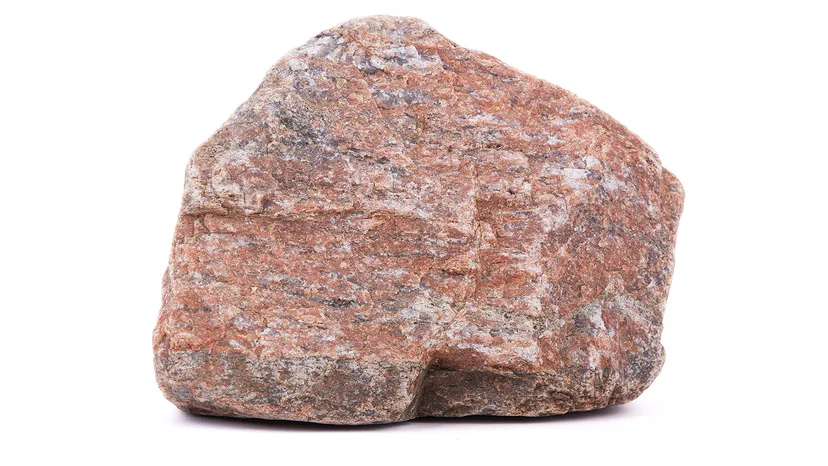
Understanding the difference helps explain why granite extrusive or intrusive is such a commonly searched question. People often mix them up because both start from magma. Here’s a clear breakdown:
| Feature | Intrusive (Plutonic) | Extrusive (Volcanic) |
| Where it cools | Below the surface | At or above the surface |
| Cooling speed | Slow (millions of years) | Fast (hours to years) |
| Crystal size | Large, visible grains | Fine-grained or glassy |
| Texture | Coarse | Fine or smooth |
| Examples | Granite, Gabbro, Diorite | Basalt, Obsidian, Pumice |
| How we see it | After erosion exposes it | Right after volcanic activity |
The key takeaway: crystal size tells you everything. Coarse texture = slow cooling = intrusive. Fine or glassy texture = fast cooling = extrusive.
Is Granite Intrusive or Extrusive?
Let’s be direct. Granite is intrusive not extrusive. It forms deep inside the Earth’s crust when large bodies of magma, called plutons, push into surrounding rock and cool very slowly over millions of years.
Granite intrusive or extrusive is a question with one clear answer: intrusive. Always. Granite never forms at the surface. It requires the kind of slow, pressurized cooling environment that only exists underground.
Here’s what that process looks like step by step:
- Magma forms deep in the mantle or lower crust
- It rises and pushes into the surrounding rock
- The magma gets trapped it can’t break through
- Over millions of years, it cools slowly
- Minerals crystallize and grow into visible grains
- The result is granite solid, coarse, and incredibly hard
The granite you see at the surface today was once buried miles underground. Erosion over millions of years stripped away the rock above it, exposing the granite we now quarry and use.
This is also why granite is intrusive or extrusive confusion comes up in classrooms. Students learn that both types start as magma. The difference is what happens next: does the magma escape, or does it stay buried?
For granite, it always stays buried. That’s what makes it intrusive.
You can read about: Concrete vs Granite Countertops
The Minerals in Granite
Granite’s look and color come from its mineral composition. The three main minerals are:
Quartz — Usually clear or white. Very hard (7 on the Mohs scale). Gives granite its glassy specks and contributes to its durability.
Feldspar — The most abundant mineral in granite. Comes in two types: orthoclase (pink or white) and plagioclase (white to gray). Feldspar controls much of granite’s base color.
Mica — Usually appears as dark, shiny flakes. Two common types: biotite (dark brown or black) and muscovite (silver or gold). Adds depth and shimmer to the stone.
In addition to these three, granite can contain smaller amounts of:
- Amphibole (dark minerals like hornblende)
- Pyroxene
- Zircon
- Apatite
- Magnetite
The exact mix of these minerals and the conditions under which they cooled determines how any given granite looks.
Minerals Found in Granite: Colors Explained
One of the most common questions people have when buying granite is: why are there so many colors? The answer is mineral composition.
White or light gray granite — High in quartz and white feldspar. Low in dark minerals. Examples: Alaska White, Colonial White.
Pink or salmon granite — High in orthoclase feldspar, which is naturally pink. Examples: Rosa Porrino, Balmoral Red.
Black granite — High in dark minerals like hornblende and pyroxene. Often technically a gabbro rather than true granite, but sold as granite. Examples: Absolute Black, Zimbabwe Black.
Blue granite — Rare. Contains a blue feldspar called labradorite. Examples: Azul Bahia, Blue Pearl.
Green granite — Contains green minerals like chlorite or epidote. Examples: Verde Ubatuba, Forest Green.
Multicolored or speckled — Most common. A mix of several minerals in varying amounts. Examples: Santa Cecilia, Giallo Ornamental.
No two granite slabs are exactly alike. That’s the nature of a rock that formed over millions of years under unique underground conditions.
Granite as a Countertop
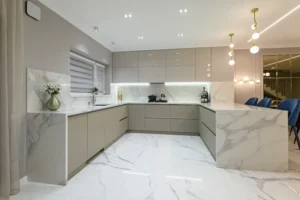
Now that you know granite is intrusive igneous rock, it makes sense why it’s such a popular choice for countertops. The same properties that come from deep-earth formation make it ideal for kitchens and bathrooms.
Why granite works well as a countertop:
- Hardness — Granite scores 6 to 7 on the Mohs hardness scale. Knives won’t scratch it easily.
- Heat resistance — Hot pots and pans won’t damage it. This comes directly from granite’s high-temperature origin.
- Natural beauty — Every slab is unique. No manufactured material replicates it.
- Durability — Properly sealed granite can last decades without cracking or staining.
- Hygiene — Sealed granite is non-porous. Bacteria can’t penetrate the surface.
One thing to keep in mind: granite is heavy. It needs proper cabinet support. And it does require sealing once a year is usually enough to keep it resistant to stains and moisture.
Other Kinds of Stones Used in Countertops and Design
Granite isn’t the only stone used in homes and buildings. Here’s how it compares to other popular options:
Marble — Also a natural stone, but not igneous. Marble is metamorphic it forms when limestone gets exposed to heat and pressure. It’s softer than granite and more prone to staining. Beautiful, but higher maintenance.
Quartzite — A metamorphic rock made from sandstone. Harder than marble, similar to granite. Often confused with quartz countertops (which are engineered, not natural).
Slate — A fine-grained metamorphic rock. Dark, smooth, and often used for flooring and roofing.
Basalt — An extrusive igneous rock. Fine-grained and dark. Used in flooring and outdoor applications. The volcanic counterpart to granite in the igneous rock family.
Soapstone — A soft, talc-rich metamorphic rock. Heat-resistant and used in countertops and lab surfaces.
Engineered Quartz — Not a natural rock. Made from crushed quartz mixed with resin. Very uniform in appearance, non-porous, and low maintenance but lacks the natural variation of granite.
Each material has its strengths. Granite remains one of the best all-around choices for durability, heat resistance, and natural beauty.
How Does Granite Get to the Surface?
This is a question geology students often ask if granite forms deep underground, how do we mine it?
The answer is erosion and tectonic uplift. Over millions of years, the rock and soil above granite formations gets worn away by wind, water, and ice. At the same time, tectonic forces can push rock formations upward. Eventually, the granite gets exposed at the surface.
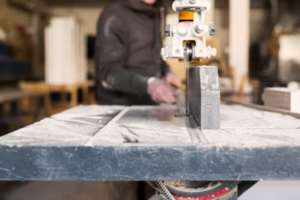
Once exposed, quarrying companies cut large blocks from the earth using diamond-tipped saws and wire cutting machines. These blocks are then sent to fabricators who slice them into slabs, polish them, and ship them around the world.
The granite on your countertop may have formed 100 million years ago or longer. That’s not a marketing claim. It’s geology.
Conclusion
By now, you should have a clear answer to is granite intrusive or extrusive. Its slow cooling process deep inside the Earth makes it the durable, beautiful stone we use today. Whether you are studying for a test or picking out new surfaces for your house, knowing the origin of the stone is helpful.
If you are looking for high-quality stone for your next project, SF Marble & Granite can help. We specialize in finding the perfect slabs that fit your style and needs. For expert help with Granite Countertop Installation in Lowell, MA, our team is ready to provide the best service and craftsmanship.
FAQs
Is granite intrusive or extrusive?
Granite is intrusive. It forms underground when magma cools slowly, never reaching the Earth’s surface. This slow process creates its coarse, crystal-rich texture.
What does intrusive mean in rocks?
Intrusive means the rock formed below the Earth’s surface. Magma cooled slowly underground, allowing large mineral crystals to grow. Intrusive rocks are also called plutonic rocks.
Is granite extrusive or intrusive can it ever be extrusive?
No. Granite is always intrusive. Its coarse grain structure is only possible with slow underground cooling. Extrusive rocks that cool quickly at the surface have fine or glassy textures not granite’s large crystals.
What is the extrusive equivalent of granite?
Rhyolite. It has a similar chemical composition to granite but forms at the surface through volcanic activity. The difference is texture rhyolite is fine-grained; granite is coarse.
Why does granite have large crystals?
Because it cools slowly underground. The slower the cooling, the more time crystals have to grow. Granite can take millions of years to fully solidify, which is why its crystals are large enough to see with the naked eye.
Is all granite the same?
No. Granite varies significantly in color, mineral content, and pattern depending on where it formed and what minerals were present. No two slabs are identical.
Is granite a good countertop material?
Yes. Granite is hard, heat-resistant, naturally beautiful, and durable. It requires periodic sealing but holds up very well in kitchens and bathrooms over the long term.
How old is granite?
It depends on the formation. Some granite is around 300 million years old. Others are much older. The granite in places like the Canadian Shield is over 2.5 billion years old.