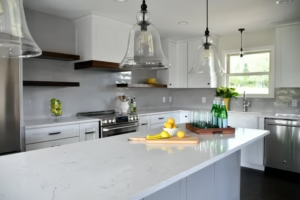
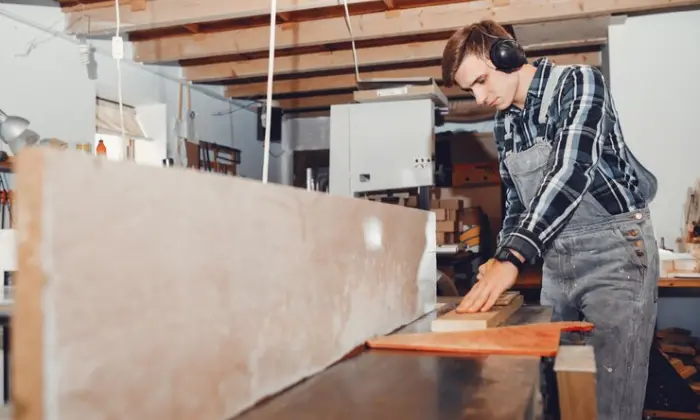
What is Engineered Marble?
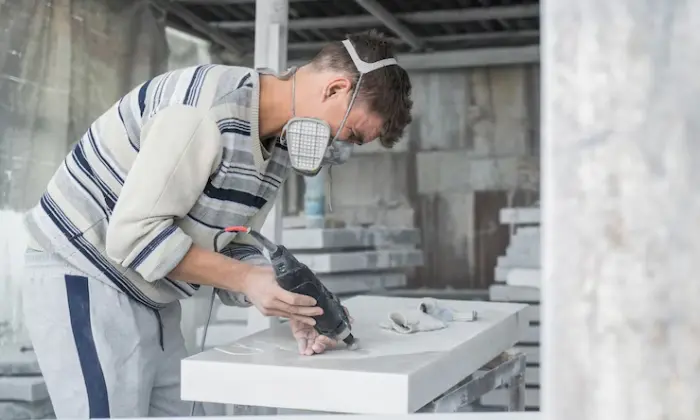
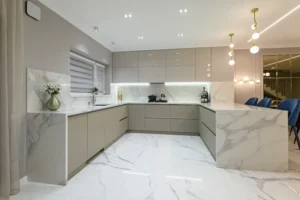
Engineered marble is a man-made surface material constructed from roughly 90 to 95 percent natural crushed marble bound together with polymer resins. This process produces a durable, non-porous slab that offers the appearance of quarried stone without natural veining flaws or heavy liquid absorption.
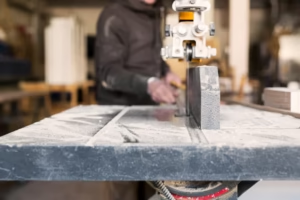
Manufacturers grind natural marble remnants into precise particle sizes. They mix those particles with liquid resin binders, coloring agents, and strength additives. The wet mixture goes into a heavy industrial mold.
Under intense vacuum pressure and heat, the mixture solidifies into a slab. This process eliminates microscopic air pockets. The finished product provides a predictable pattern, smooth feel, and strong seal against spilled liquids.
What is Natural Marble?
Natural marble is a metamorphic rock formed when limestone gets exposed to intense heat and pressure inside the earth over millions of years. Quarried in large blocks and cut into slabs, it contains calcium carbonate, which gives it a soft, porous surface with unique veining that no two slabs share exactly.
That calcium carbonate content is the reason marble reacts to lemon juice, vinegar and other acids. It’s also what makes each slab one of a kind. No two blocks come out of the quarry with the same pattern, so a marble floor or countertop carries a kind of visual signature a factory can’t fully copy.
Engineered Marble Vanity Top
Bathroom counters face constant exposure to water, soap scum, toothpaste, and grooming products. An engineered marble vanity top provides an ideal solution for high-use bathrooms because water cannot seep into the sealed material.
Most vanity tops feature integrated sink basins molded directly into the counter surface. This seamless construction eliminates the rim gap where grime, water, and mold usually gather.
Cleaning requires only a quick wipe with warm water and mild dish soap. You never need to purchase expensive specialized stone sealers or worry about liquid soap discolored patches.
Engineered Marble vs Cultured Marble
Engineered marble uses a high percentage of real stone aggregate bound by resin throughout its entire thickness. Cultured marble relies on a liquid polymer resin base poured into molds, then covered with a thin protective clear gel coat on top.
| Feature | Engineered Marble | Cultured Marble |
| Stone Content | 90% to 95% crushed marble aggregate | 75% calcium carbonate powder |
| Surface Finish | Solid color and pattern through full depth | Top layer gel coat protection |
| Scratch Repair | Sandable and buffable like solid stone | Scratches through gel coat expose core |
| Appearance | Realistic stone feel and weight | Slightly plastic or glossy finish |
While both options handle moisture well, composite stone slabs handle minor scratches much better. If you scratch a composite slab, a technician can buff the surface smooth again. A deep scratch on cultured surfaces can crack the gel coating, exposing the softer core underneath to moisture.
Engineered Marble vs Quartz
Quartz and engineered marble both fall under the “engineered stone” umbrella, but the aggregate inside them is different, and that changes everything about how they perform. Quartz slabs use crushed quartz crystal, one of the hardest common minerals, sitting around 7 on the Mohs hardness scale. Engineered marble uses crushed marble, which sits closer to 3 or 4.
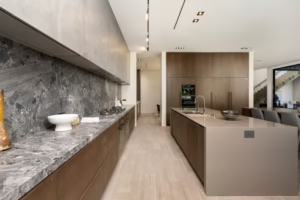
That hardness gap matters at the kitchen sink. Quartz resists scratches and stays put against most acids, since the quartz mineral itself doesn’t react to lemon juice or vinegar the way calcium carbonate does. Engineered marble still etches under acidic spills, just less dramatically than natural marble does, because the resin slows the reaction without stopping it. What engineered marble wins back is looks. It carries the soft veining and depth of real marble in a way quartz’s more uniform pattern usually can’t match.
What are the Benefits of Engineered Marble?
Non-porous surface: Prevents moisture, bacteria, and mold from growing inside the material.
Easy maintenance: Cleans up quickly with standard household soap and water.
Cost control: Delivers a luxurious stone appearance at a fraction of natural stone slab prices.
Seamless fitting: Allows molded sinks and wall panels that eliminate dirt-collecting grout lines.
Consistent appearance: Eliminates random color variations, natural cracks, or hidden weak points.
What are the Applications of engineered marble?
Thanks to its water resistance, composite stone works well in damp environments across the home.
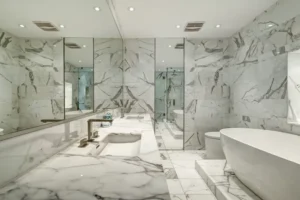
Shower wall panels: Large slabs create smooth shower enclosures without grout lines to scrub.
Bathroom vanity counters: Integrated sinks create clean, easy-to-reach surfaces.
Window sills: Resists sun fading and condensation puddles near window frames.
Thresholds and entry steps: Provides flat, smooth transition strips between room floorings.
Tub surrounds: Covers deep soaking tub alcoves with durable, water-resistant walls.
How to install Engineered Marble?
Installing composite stone panels involves measuring the space, cutting panels to fit plumbing fixtures, applying construction adhesive, pressing panels onto drywall, and sealing all open joints with silicone caulk.
Prepare the walls: Ensure drywall or backer board surfaces stay clean, flat, and completely dry.
Measure and mark: Measure wall dimensions carefully, including shower valves and pipe locations.
Cut the slab: Use a circular saw with a diamond blade to make straight cuts along marked lines.
Apply adhesive: Spread heavy-duty masonry or panel adhesive in vertical lines across the wall backer.
Set the panel: Press the composite panel firmly against the wall, leveling it before the glue sets.
Seal the edges: Apply 100 percent silicone sealant along corner joints and around faucet fixtures.
Elevate Your Home with Engineered Marble Solutions
At SF Marble & Granite Inc, we extend these benefits through our expert services, including stunning Marble Floor Installation in Lowell that transforms your home with style and longevity. Contact us today!
Conclusion
In conclusion, What is engineered marble and how to install it involves careful preparation, accurate measurement, and meticulous execution to achieve a flawless finish. From preparing the surface to sealing the final installation, each step contributes to a professional and durable outcome. For those looking to enhance their space with high-quality engineered marble, proper installation is key to ensuring both aesthetic appeal and long-term performance.
If you have any questions or need assistance with your marble installation project, feel free to contact us. At SF Marble Granite we specialize in engineered stone products and are committed to delivering exceptional quality and service. Reach out to us today to learn more about our products and how we can help you transform your home with beautiful, durable marble.
FAQs
Can engineered marble be polished?
Yes, technicians can polish engineered marble using fine diamond polishing pads and low-speed polishers. Buffing removes light surface scratches and restores the original shine.
Is engineered marble heat resistant?
Engineered marble resists warm water, but direct heat above 300 degrees Fahrenheit can scorch the resin binders. Always use heat pads under curling irons or kitchen cookware.
How do you clean engineered marble surfaces?
Clean the surface using warm water, a soft microfiber cloth, and mild dish soap. Avoid harsh chemical cleaners, bleach, or abrasive scrubbing sponges that dull the surface finish.
Does engineered marble scratch easily?
It resists everyday wear, but sharp metal tools or abrasive pads can scratch it. Minor scratches polish out easily using specialized polishing compounds.