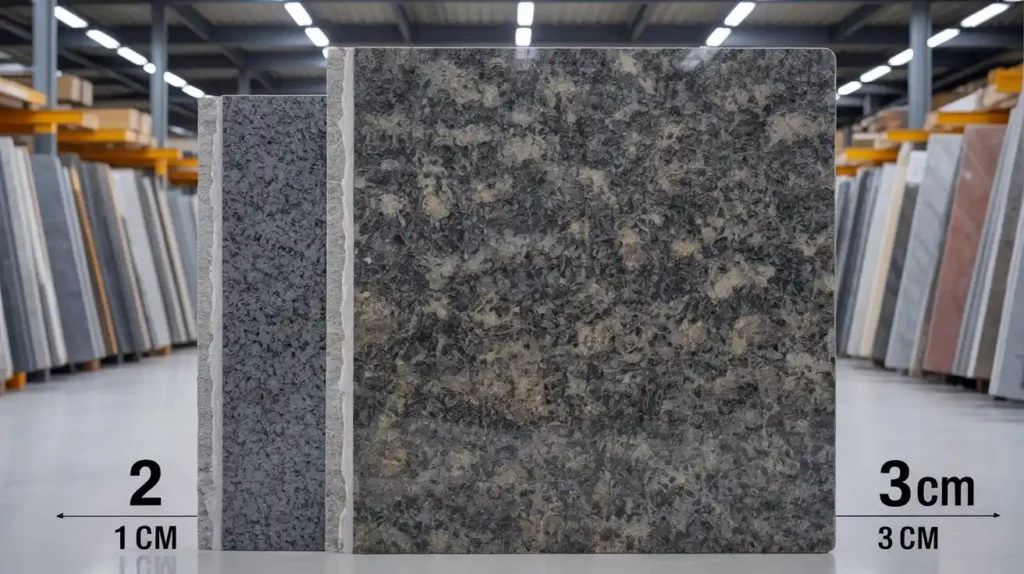
The weight of granite depends primarily on thickness. Here is how the numbers break down by slab thickness:
- 2 cm (3/4 inch) granite: 12 to 14 pounds per square foot
- 3 cm (1.25 inch) granite: 18 to 20 pounds per square foot
Most residential kitchen countertops today use 3 cm granite. It is the industry standard for countertop applications because of its structural strength and substantial feel. The 2 cm option is thinner, lighter, and occasionally used for bathroom vanity tops or vertical applications like backsplashes.
To put those numbers in real-world terms:
- A 10 square foot bathroom vanity top (3 cm): roughly 180 to 200 pounds
- A 30 square foot kitchen countertop (3 cm): roughly 540 to 600 pounds
- A 50 square foot large kitchen with island (3 cm): roughly 900 to 1,000 pounds
Those are significant numbers. Understanding them before your installation helps you prepare your cabinets, your floor, and your installation plan correctly.
Why Does the Weight of Granite Matter?
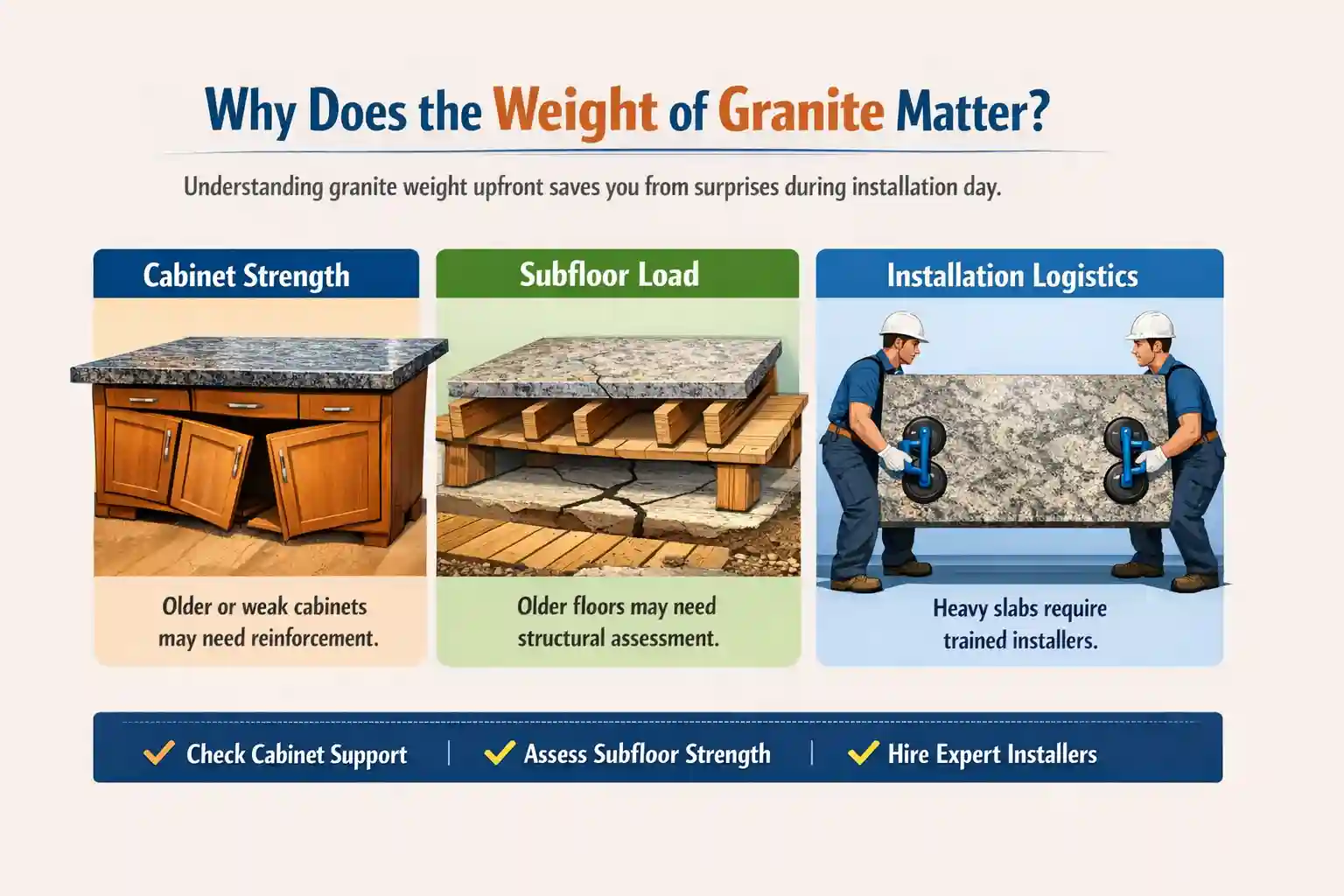
The weight of granite dictates whether your existing cabinets require extra bracing, if your subfloor needs reinforcement, and how many installers are required to handle the slabs safely.
Ignoring slab weight can cause severe structural damage over time. Standard kitchen cabinets are built to support typical countertop materials, but natural stone places continuous downward force on cabinet frames and floor joists.
Here are the primary reasons weight planning is essential:
-
Cabinet Structural Integrity: Unsupported spans or weak cabinet frames can bow or crack under hundreds of pounds of stone.
-
Flooring & Subfloor Support: Older homes or long floor spans may require additional joist reinforcement beneath heavy kitchen islands.
-
Transportation & Handling: Moving a 500-pound slab through narrow hallways requires specialized equipment and trained labor to prevent dangerous drops or fractures.
-
Precision Fabrication: Cutouts for sinks and cooktops create thin, vulnerable points in the stone that crack easily if supported incorrectly during transit.
Factors That Affect Granite Countertop Weight
Not all granite weighs the same, even at the same size. A few things change the final number.
Thickness is the biggest factor. Granite comes in three common thicknesses: 2cm, 3cm, and occasionally a thicker slab for waterfall edges. A 3cm slab weighs close to 50% more per square foot than a 2cm slab.
Density varies by quarry and mineral makeup. Some granite colors, like darker stones with more mineral density, run slightly heavier than lighter, more porous varieties. This difference is small compared to thickness, but it adds up over a large counter run.
Edge profile adds weight too. A simple eased edge barely changes the total. A thick bullnose or a built-up laminated edge, where two pieces of stone are glued together to look like a single thick slab, adds noticeable pounds along that edge.
Cutouts for sinks, cooktops, and outlets actually reduce total weight, since material is removed. It’s a small reduction, usually a few pounds per cutout, but it’s part of the full calculation.
Granite Weight Per Square Foot Explained
Granite weighs approximately 160 to 170 pounds per cubic foot. Translating that cubic density into square-foot measurements helps you estimate the total load for your counters.
| Thickness | Weight per Sq. Ft. | Average 30 Sq. Ft. Counter | Average 50 Sq. Ft. Kitchen |
| 2cm (3/4″) | 13 – 15 lbs | 390 – 450 lbs | 650 – 750 lbs |
| 3cm (1 1/4″) | 18 – 20 lbs | 540 – 600 lbs | 900 – 1,000 lbs |
| 3cm Custom Edge | 20 – 22 lbs | 600 – 660 lbs | 1,000 – 1,100 lbs |
To calculate your total weight, multiply your surface area (length x width in feet) by the square-foot weight corresponding to your chosen slab thickness.
Can Cabinets Hold Granite Weight?
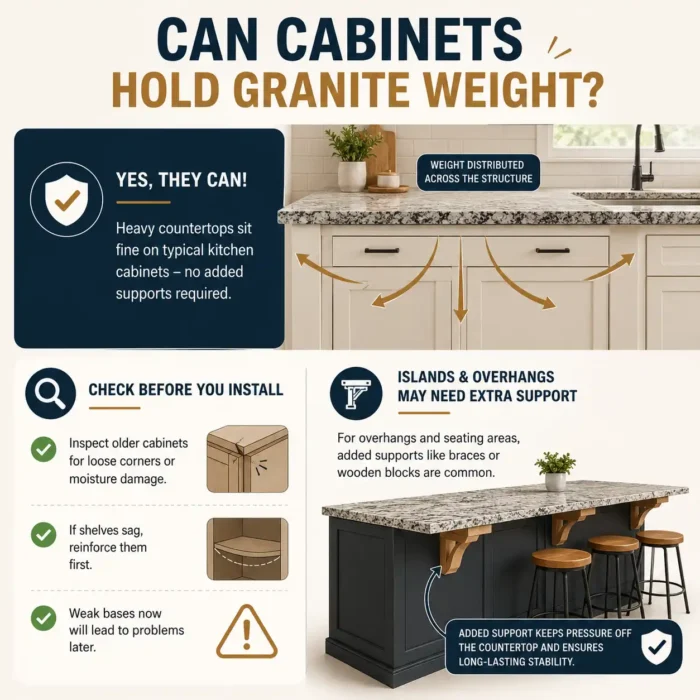
Yes, standard factory-built base cabinets can easily hold granite weight if they are level, structurally sound, and installed flush against wall studs.
Base cabinets distribute weight vertically down their side panels, which offer immense load-bearing strength. However, issues arise when cabinets are unlevel or have hollow gaps beneath the stone.
Checking Your Cabinet Readiness:
-
Levelness: Use a 4-foot level across all base cabinets. A gap greater than 1/16 inch creates a pressure point that can crack the stone.
-
Plywood Sub-tops: Always install 5/8-inch exterior-grade plywood over cabinets when using 2cm granite.
-
Cantilevered Support: Use hidden steel support bars spaced every 24 inches for island overhangs.
Granite vs. Other Countertop Materials (Weight Comparison)
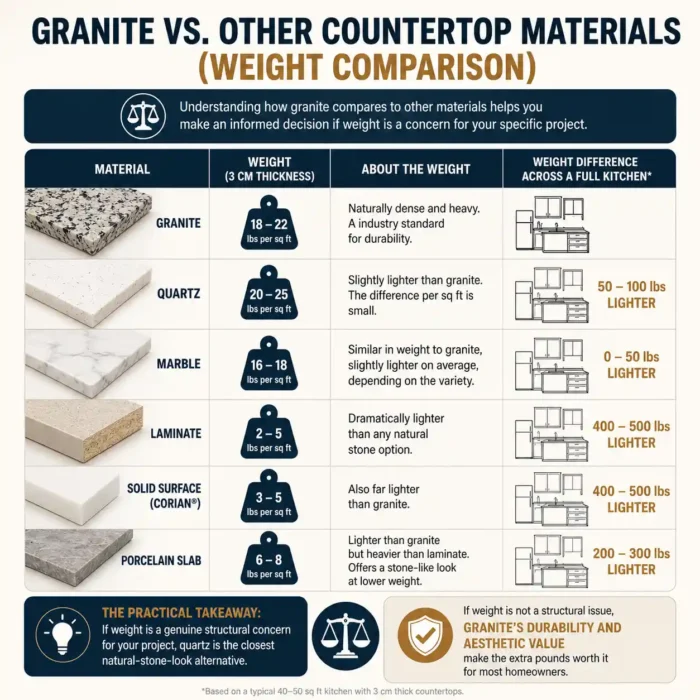
Granite sits on the heavier end of the countertop spectrum, but it’s not alone up there.
- Granite: 12–20 lbs per square foot, depending on thickness
- Quartz: slightly heavier than granite at the same thickness, often 15–20 lbs per square foot, since it’s an engineered blend of stone and resin
- Marble: close to granite, generally 12–18 lbs per square foot
- Butcher block: 3–5 lbs per square foot, far lighter
- Laminate: laminate countertop weight per square foot runs about 2–3 lbs, making it one of the lightest options on the market
If your cabinets are already a concern, this comparison matters. Someone asking how much does granite weigh is often really asking whether they need to switch materials entirely, and knowing where granite lands next to quartz or laminate makes that decision a lot easier.
You may also read: How to Treat Granite Countertops
How Granite Weight Impacts Installation
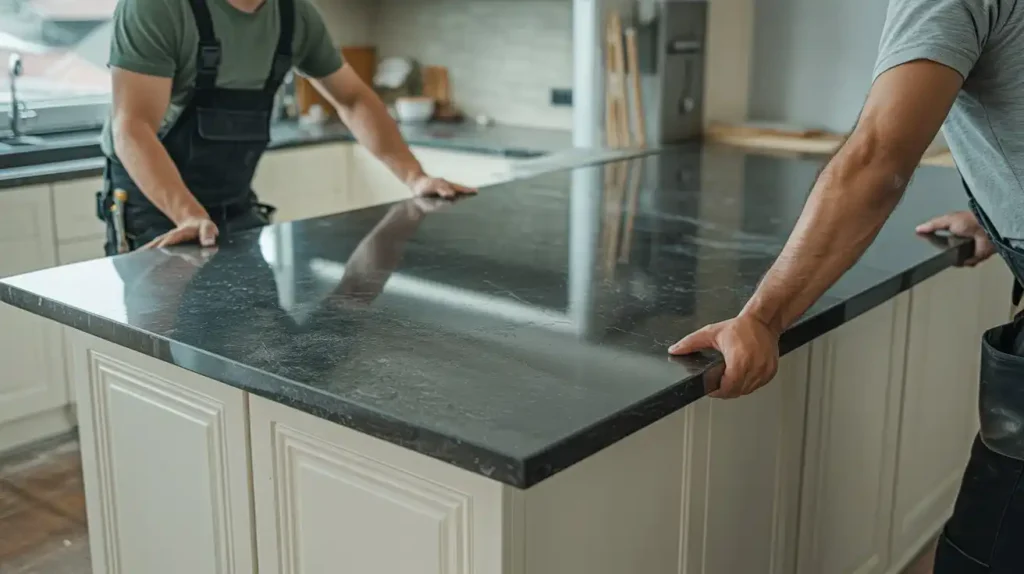
Weight changes almost everything about installation day, starting with how many people show up. A single 3cm slab for a kitchen island can weigh 300 pounds or more on its own, which means it takes a trained crew with the right rigging, not two guys and a dolly.
It also changes how the slab gets into your house. Doorways, stairwells, and tight hallway turns all get measured ahead of time, because a slab that’s too heavy to maneuver around a corner has to be cut on site or brought differently. This is one of the most common reasons installations get delayed.
Finally, weight affects how the slab gets set. Installers use suction cups and specialized carts, not brute strength, to move and place granite without cracking it. Skipping that equipment is how corners chip and edges crack before the job’s even finished.
Installation Considerations
Before delivery day, run through this structural safety checklist:
-
Clear a wide pathway from your entryway to the kitchen or bathroom.
-
Verify floor joist integrity beneath large kitchen islands.
-
Secure plumbing disconnects before removing old counters.
-
Confirm undermount sink brackets are rated for your sink’s filled weight plus garbage disposal units.
Why Choose Us for Granite Countertops Installation in Lowell, MA
If you are planning a granite countertop project in the greater Lowell area, working with a specialist who handles granite every day makes a real difference in the final result.
SF Marble & Granite provides expert Granite Countertops Installation in Lowell, MA with a full-service process slab selection, templating, fabrication, and professional installation handled by an experienced stone crew. We inspect cabinet levelness before setting any stone, use proper support equipment throughout the installation, and seal every natural stone surface before we leave.
Our team has installed thousands of granite projects across Greater Boston and understands the specific challenges of residential granite work from tight installation paths to complex kitchen layouts with islands and specialty edge profiles.
Contact us today for a free in-home estimate and a realistic project timeline for your granite countertop installation.
Final Thoughts
How heavy are granite countertops? At 18 to 20 pounds per square foot for standard 3 cm thickness, a full kitchen installation weighs 400 to 700 pounds or more. That weight matters for cabinet integrity, installation logistics, and structural planning but it does not make granite a difficult or impractical choice for most homes.
Standard residential cabinets handle granite weight well. Professional installation crews handle the logistics. And the durability, heat resistance, and natural beauty that come with granite’s density make it one of the most rewarding long-term countertop investments available.
Plan correctly, choose a professional installer, and your granite countertops will serve your kitchen well for decades.
Frequently Asked Questions (FAQs)
How heavy are granite countertops for a standard kitchen?
A standard kitchen with 30 to 40 square feet of 3 cm granite countertop weighs 540 to 800 pounds total. Larger kitchens with islands can reach 900 to 1,100 pounds of total granite weight. These figures include all countertop runs but not the weight of the base cabinets themselves.
How much does granite weigh compared to quartz countertops?
Granite weighs 18 to 20 pounds per square foot at 3 cm thickness. Quartz weighs 20 to 25 pounds per square foot at the same thickness — making quartz slightly heavier than granite in most comparisons, contrary to what many homeowners expect. Both materials require the same professional installation approach.
What is the weight of granite per cubic foot?
The weight of granite per cubic foot ranges from 160 to 175 pounds depending on the specific granite variety and its mineral density. This measurement is most useful for structural load calculations. For practical installation planning, the per-square-foot measurement 18 to 20 pounds for 3 cm is the more useful figure.
Is granite heavy enough to require cabinet reinforcement?
In most standard residential kitchens with modern cabinets, no reinforcement is needed. Standard kitchen cabinets are designed to support 600 to 1,000 pounds of countertop load distributed across the base. Reinforcement is needed for overhangs exceeding 12 inches, unsupported spans, and older or structurally compromised cabinets.
How heavy is granite per square foot for 2 cm versus 3 cm slabs?
A 2 cm granite slab weighs approximately 12 to 14 pounds per square foot. A 3 cm slab weighs 18 to 20 pounds per square foot. For a 30 square foot kitchen, that is the difference between 360 to 420 pounds (2 cm) and 540 to 600 pounds (3 cm). Most residential kitchen countertops use 3 cm for structural strength and aesthetic depth.