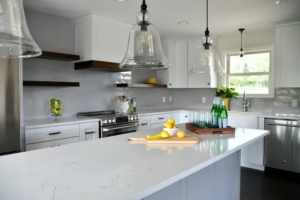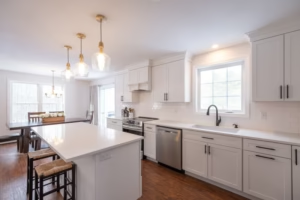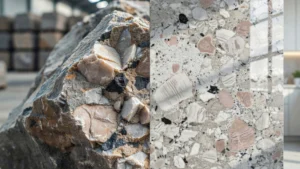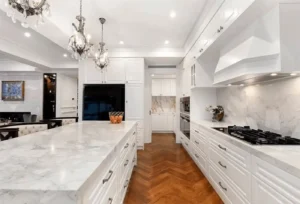

You’re in your kitchen and you feel something is wrong. Maybe it’s the beige cabinets you put in 2004, or the countertops that looked so good in the showroom but look dingy in your own lighting. There’s nothing wrong with wanting a change. A kitchen should be the best room in the house not the one you don’t want to show off.
Here’s what we can assure you: this guide will provide you a genuine plan, not just attractive graphics. If you’re seeking for ways to remodel your kitchen with black cabinets and white countertops, you want to know what genuinely works together, what stands up over time, and what mistakes to skip. We’ll walk through cabinet finishes, countertop materials, lighting, backsplash choices, flooring, and the minor elements that distinguish a kitchen that looks excellent on day one from one that still looks good five years later.

The Appeal of Black Kitchen Cabinets
Black cabinets work because they do something white or beige cabinets can’t. They give a room weight and definition. A kitchen with black lower cabinets reads as intentional, almost tailored, the way a good dark suit does.
They’re also more forgiving day to day. Fingerprints, water spots, and small scuffs show up fast on white cabinetry. On black, especially a matte or satin finish, they blend in. That’s a real advantage if you cook often or have kids running through the kitchen.
Black doesn’t have to mean heavy or cold. Paired with the right countertop and enough light, it can feel warm and grounded instead. The trick is balance, which is exactly why the next material matters so much.
White Countertops: A Perfect Contrast
White and black cabinetry – the sort of contrast designers want on purpose. White brings light back into the room, so a dark-cabinet kitchen doesn’t feel like a cave. It also makes the black look crisper, not so heavy.
But not all white counters are alike. Quartz, marble and quartzite all look “white” from across the room, but they act differently under your hands and your budget. Marble is a natural stone with soft veining, but it’s porous and prone to etching from acid, so lemon juice or vinegar left too long can leave a dull mark. Quartzite, a natural stone that’s often confused with quartz, brings similar veining with far better hardness and scratch resistance.
Engineered quartz, meanwhile, isn’t natural stone at all. It’s a manufactured slab made from crushed stone and resin, which makes it non-porous and low maintenance without any sealing required. Whatever you decide, the countertop is doing more than half the visual work in this kind of kitchen, so it’s worth spending real time on the sample, not just a photo online.
Combining Black Cabinets with White Countertops
The reason to alter your kitchen with black cabinets and white counters boils down to contrast that doesn’t fight itself. Black grounds the room. White lifts it back up. Together, they read as clean and modern instead than antiquated the way an all-white or all-wood kitchen from a decade ago can.
Ratio matters more than people assume. A kitchen with too much black can feel locked in, especially in a smaller area with limited views. A frequent approach is black lower cabinets with white or light upper cabinets, or open shelves, so the eye has somewhere to rest. If you’re going full black on all cabinetry, lean on a white countertop with movement, like veining or flecks, to keep the space from feeling flat.
Undertones deserve attention too. A warm white countertop can clash with a chilly, blue-black cabinet, and the mismatch is subtle but evident if you live with it. Bring a cabinet door sample and a countertop slab piece into the same room, under your actual illumination, before you commit to either.
Choosing the Right Countertop Material for Durability
The best countertop for a black-and-white kitchen depends on how you cook and your budget, but quartzite and quartz are the two strongest choices. Quartzite offers natural stone beauty with strong scratch and heat resistance, while quartz gives near-zero maintenance with consistent color and no sealing required.
If you’re set on a natural stone look, quartzite kitchen countertops are worth the extra research. Real quartzite has a hardness close to that of a diamond on the geological scale, so it resists scratching from knives and daily use far better than marble. It still needs periodic sealing, since it’s a porous surface like other natural stone, but a good sealer keeps stains and etching at bay for a year or more at a time.
If low upkeep matters more than natural veining, a premium countertop material like engineered quartz gives you durable kitchen surfaces without the sealing schedule. It’s also naturally heat resistant and scratch resistant enough for everyday cooking, though a hot pan straight off the stove is still a bad idea on any surface. For homeowners chasing a luxury kitchen countertops look on a tighter budget, a quartz slab with dramatic white-and-gray veining can pass for natural stone at a glance.
Lighting and Ambiance
Lighting decides whether a black-and-white kitchen feels sharp or simply dark. Under-cabinet LED strips are close to mandatory here, since they light the countertop directly where you’re chopping and cooking, and they keep shadows from pooling under black upper cabinets.
Layer your light sources instead of relying on one ceiling fixture. Recessed cans handle general brightness, a pendant or two over an island adds a focal point, and under-cabinet lighting covers the work zones. Warm white bulbs, somewhere around 2700 to 3000 Kelvin, keep the room from feeling clinical next to all that black and white.
Natural light matters just as much. If your kitchen has a window over the sink, skip heavy window treatments that block it. A bright kitchen makes dark cabinetry feel like a design choice, while a dim one can make the same cabinets feel like a mistake.
Backsplash Ideas for Black and White Kitchens
A backsplash is your chance to add texture without touching the cabinet or countertop color scheme. Classic white subway tile is the safe, timeless option, and it lets the black cabinets and white countertop do the talking. Set it in a herringbone pattern instead of a straight grid for a bit more personality without adding color.
If you want more contrast, a black-and-white marble mosaic or a geometric tile pattern picks up both colors already in the room. Just keep the scale of the pattern in check. A busy backsplash next to a busy countertop can make the whole kitchen feel crowded rather than designed.
Grout color is a small detail that changes everything. Dark grout on white subway tile reads as intentional and modern, while white grout keeps things soft and traditional. Either way, test a small tile board with your actual cabinet sample before ordering the full run.
Flooring Options to Complement the Design
Flooring anchors a black-and-white kitchen the same way a rug anchors a living room. Light wood floors, in oak or ash tones, keep the room from feeling too stark, since they add warmth without competing with the countertop. Dark wood or wood-look tile can work too, but it pulls the room’s weight downward, so it pairs best with a kitchen that already has good natural light.
Large-format porcelain tile in a light gray or warm white is a practical option for households with pets or frequent spills, since it holds up to moisture better than solid hardwood. Some homeowners also go with a black-and-white checkerboard floor, a nod to classic diner style, though it’s a bold choice that can date faster than a simple neutral.
Whatever you choose, keep the floor’s undertone in mind alongside your countertop’s undertone. A cool gray floor next to a warm white countertop can create the same subtle clash mentioned earlier with cabinet finishes.
Cabinet Hardware and Finishing Touches
Hardware is a small line item that changes the whole feel of black cabinetry. Brushed brass or gold pulls add warmth and a touch of the luxury kitchen countertops look mentioned earlier, while matte black or brushed nickel hardware keeps things sleek and blends into the cabinet color.
Cabinet style matters too. A shaker-style door with black paint feels current without chasing a trend that fades in a few years, while a flat slab door leans more modern and minimal. Both work with white countertops, so this decision comes down to your own taste and how the rest of your home is finished.
Don’t skip the sink and faucet. A matte black faucet against a white countertop repeats the color story in a small, sharp detail, while a brushed brass faucet softens the contrast if you went heavy on black cabinetry elsewhere.
Cost Considerations for a Kitchen Remodel
A black-and-white kitchen remodel typically costs more for the countertop than the cabinets, since natural stone and premium quartz run higher per square foot than paint or standard cabinet refacing. Budgeting separately for cabinets, countertops, and labor gives a clearer picture than one lump estimate.
Painting existing cabinets black is far cheaper than replacing them, and it’s a realistic option if your current cabinet boxes are in good shape. New cabinetry costs more but solves layout and storage problems paint can’t fix. Either path, get at least two contractor quotes before you commit, since kitchen remodeling costs can swing widely by region and material choice.
Countertops are usually priced per square foot installed, and that price changes fast between engineered quartz, quartzite, and marble. A local fabricator can walk you through slab options in person, which matters more than any online price list, since seams, edge profiles, and cutouts for sinks or cooktops all affect the final number.
Final Tips for Designing a Modern Black-and-White Kitchen
Start with the material you’re least willing to compromise on, whether that’s the countertop slab or the cabinet finish, and build the rest of the kitchen around it. Trying to match everything equally usually ends in a kitchen that feels indecisive instead of designed.
Order physical samples before you buy anything. A cabinet door sample, a countertop slab remnant, a tile sample, and a flooring swatch, placed together under your kitchen’s actual lighting, will tell you more in five minutes than weeks of scrolling photos online.
If your project includes natural stone, work with a fabricator who handles installation regularly rather than a general contractor subcontracting it out. For homeowners in the area considering Granite Countertop Installation in Lowell, SF Marble and Granite handles sourcing, templating, and installation as one process, which cuts down on the back-and-forth between a cabinet installer and a separate stone supplier.
Final Thoughts
A black-and-white kitchen isn’t a passing look. It’s a pairing that’s worked for decades because the contrast does real visual work, not just decoration. Get the undertones right, spend real money on the countertop material, and light the room properly, and the rest tends to fall into place.
If you’re ready to move past planning and into real materials, contact us at SF Marble and Granite to see slabs in person and get a straight answer on what fits your kitchen and your budget.
FAQs
Do black cabinets make a small kitchen look smaller?
Black cabinets don’t automatically shrink a small kitchen, but poor lighting and a lack of contrast can. Pairing black lower cabinets with white uppers or countertops, plus strong under-cabinet lighting, keeps a small kitchen feeling open rather than closed in.
The color itself isn’t the problem. A small kitchen with black cabinets, white countertops, and good natural light can feel just as open as an all-white kitchen, sometimes more interesting. The mistake is going all-black with dim lighting and no white to bounce brightness back into the room.
Are black cabinets hard to keep clean?
Black cabinets are generally easier to keep looking clean day to day than white ones, since fingerprints and small marks blend into the dark finish rather than standing out. A matte or satin finish hides smudges better than a high-gloss black.
Grease and dust still show up over time on any cabinet color, so regular wiping is still part of the routine. The real advantage is fewer visible fingerprints between cleanings, not less cleaning overall.
What’s the most durable white countertop for a busy kitchen?
Engineered quartz is the most durable choice for a busy kitchen, since it resists scratching, staining, and heat without needing regular sealing. Quartzite is a close second if you want a natural stone look with strong durability.
Marble looks beautiful but etches easily from acidic foods and drinks, which makes it a tougher fit for a household that cooks daily without much patience for maintenance. If natural stone is non-negotiable, quartzite handles daily wear far better than marble while still showing real veining.
Does black-and-white kitchen design go out of style quickly?
Black-and-white kitchen design has stayed in rotation for decades because the contrast is classic rather than trend-driven. Choosing simple cabinet door styles and a natural-looking countertop keeps the kitchen from feeling tied to one specific year.
Trends come and go in hardware finishes or backsplash patterns, but the core black-and-white pairing itself isn’t new. It shows up in kitchens from the 1950s through today, which says more about its staying power than any single design blog.