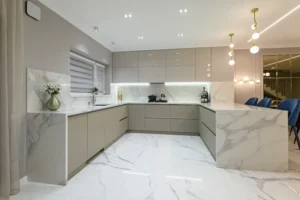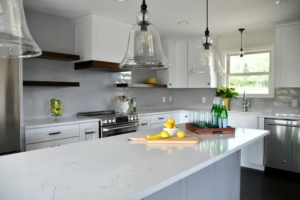
Looking for a white stone that resembles ice yet wears like armor? That’s the lure behind so many kitchen and bath remodels today. This natural stone is everywhere on stone yards, contractor mood boards and renovation forums and for once the hype is justified. You’ve come to the perfect place whether you’re curious about it next to quartz, what it costs, or if it will work in your kitchen.
White Fantasy Granite is a rare, luxury natural stone with an icy white base with gentle gray, green or faint purple veining. It is technically quartzite rather than real granite, despite the name, and therefore is tougher and more heat resistant. Great for kitchen counter, bathroom vanity or back splash. Regular granite is usually cheaper because good slabs are hard to find.
What Is White Fantasy Granite?
The term remained, but in fact White Fantasy Granite is not a granite but a quartzite. It is sandstone that has been subjected to heat and pressure for millions of years . This gives it a Mohs hardness of 7 to 8 . That hardness gives it more resistance to scratches and heat than most of the granite you will find in a stoneyard .
This is not a tactic of one provider to mislabel. “It’s going on all through the stone trade. It’s something the geologists have been pointing out for years. Granite is cooled magma. Sandstone when buried and heated and compacted becomes quartzite. The two processes are different but the finished surface looks similar enough that early stone sellers kept the name granite and it was never corrected.
Where it’s quarried is also debatable. Some suppliers source their slabs from Brazil. Some are from India’s granite belt includes Rajasthan and Andhra Pradesh. Both places create stone with the same frosty background and flowing veining, so purchasers often can’t tell provenance apart merely by glancing at a sample.
Applications of White Fantasy Granite
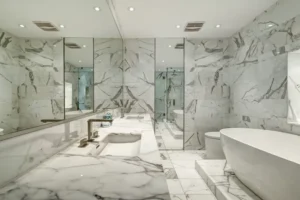
Kitchen countertops are the most common use, but they’re far from the only one. Bathroom vanity tops come in a close second, especially where homeowners want a bright, clean look without going full white quartz. Backsplashes cut from the same slab as the countertop create a matched look that a lot of designers request by name.
Flooring and wall tiles are less common but growing, mostly in entryways and accent walls where a lighter stone helps a room feel bigger. Some homeowners use it for fireplace surrounds, since the heat resistance holds up fine next to a firebox. Outdoor use stays rare because a honed surface can get slippery when wet, so fabricators usually steer patio projects toward granite or porcelain instead.
Commercial use shows up in hotel lobbies, reception desks, and high-end retail counters, where the stone’s rarity works as a quiet flex. A few boutique furniture makers use offcuts for tabletops and coffee tables, since larger remnants get expensive to haul away otherwise.
White Fantasy Granite Countertops
Countertops are where this stone earns its reputation. The pale background hides water spots better than dark granite. The veining means two seams rarely look identical, so patched slabs blend in better than you’d expect. Most fabricators recommend 3cm thickness for countertops, since anything thinner risks cracking under a sink cutout or heavy cookware.
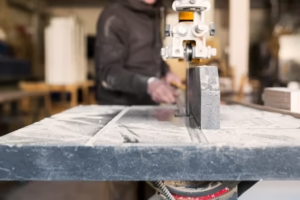
Edge profiles matter more here than with plain white quartz, because the veining runs at odd angles depending on where the slab gets cut. A beveled or bullnose edge shows off the pattern better than a sharp, squared edge, which can cut a vein off mid-line and look choppy. Ask your fabricator to lay the template on the actual slab before cutting, not just from a photo, since photos wash out subtle color shifts.
Sealing is part of the deal too. Even with lower porosity than true granite, a penetrating sealer applied once a year keeps the surface from soaking up oil or wine near the sink and stove.
White Fantasy Granite vs Quartz and Quartzite Countertops
Quartz is engineered from crushed stone and resin, so its pattern repeats and its color stays consistent slab to slab. Natural quartzite never repeats exactly, and slight color shifts are normal, not a flaw. Want a showroom-perfect match across a large kitchen? Quartz wins on consistency. Want something no other kitchen has? Natural stone wins on character.
Heat resistance favors the natural stone. Quartz contains resin, and resin can soften or discolor under direct heat from a hot pan, so most quartz brands warn against setting pans straight from the stove onto the counter. True quartzite handles that heat without issue, which matters if you cook often and don’t want to reach for a trivet every time.
Maintenance flips the advantage back to quartz. Quartz needs no sealing at all, while natural quartzite needs an annual reseal to stay stain resistant. Pricing sits close between high-end quartz brands and high-end natural quartzite, so the real decision usually comes down to whether you want a stone with a story or one with guaranteed uniformity.
Advantages of Using White Fantasy Granite
Durability tops the list. A Mohs hardness of 7 to 8 puts it above most kitchen tools and cutlery, so daily knife slips and dragged pots won’t leave marks the way they would on softer marble.
Heat tolerance comes standard, not as an upgrade. Set a hot pan down without grabbing a trivet, and the surface won’t scorch or discolor the way laminate or butcher block would.
Resale value tends to hold up too. Real estate agents and remodelers often say natural stone counters, especially rarer whites, read as a premium upgrade to buyers touring a home, more so than most engineered surfaces.
Every slab looks different, and buyers split into two camps on that. If you want your kitchen to look like nobody else’s, the natural variation is the whole point. If you need exact predictability across a long run of cabinets, that variation becomes a planning issue, so talk it through with your fabricator early.
Caring for White Fantasy Granite
Still easy to clean up on a daily basis. Wipe spills with a soft cloth and mild dish soap and then dry the surface so water does not pool and damage the sheen. Keep away from acid. Normal use wears down the sealer faster than vinegar, lemon juice, and aggressive degreasers.
Sealing once a year keeps the surface protected, although denser slabs sometimes only need it every two years. When it is due you will know with a simple water test. If the seal is still good, after a few minutes the water will form beads and not soak in.
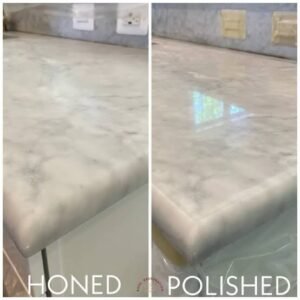
You don’t absolutely need cutting boards and trivets because of the stone’s hardness, but they will help keep the polish and prevent knife marks on a surface that you paid a lot of money for. Don’t drag heavy cast iron across the surface, either, because the polish will dull with repeated scraping, even if the stone is still in good shape.
White Fantasy Granite Slab
Slab size runs close to standard, usually 9 to 10 feet long and 5 to 6 feet wide, though exact dimensions vary by quarry block. Buying a full slab instead of remnants matters more here than with quartz, since the veining needs to flow in one direction across the counter to look intentional rather than pieced together.
Grading affects both price and appearance. Commercial grade slabs show more fractures and inconsistent veining. Premium grade slabs have fewer natural fill lines and a cleaner background color. Ask to see the actual slab in your fabricator’s yard before buying, since photos on a supplier’s site rarely capture the full range of veining you’ll see in person.
Book the whole slab if your kitchen has a large island plus perimeter counters. Splitting the run across two different slabs almost always creates a visible mismatch at the seam.
The Popularity of White Fantasy Granite
Demand for bright, light-colored stone surfaces hasn’t slowed down. Houzz’s kitchen trends research has repeatedly found white and light countertops among the top requested finishes for renovating homeowners. This stone rides that trend hard, since it delivers the bright look buyers want plus the texture and depth that flat white quartz can’t fake.
Search interest spikes seasonally too, usually rising in spring when renovation season kicks off, and again before the holidays in early fall. Regional pricing shifts with that demand, since stone yards raise prices on popular slabs when buyers shop less carefully during a renovation crunch.
Social media plays its part as well. Kitchen remodel accounts on Instagram and Pinterest keep this stone in rotation because it photographs well under most lighting, unlike some warmer-toned granites that shift color depending on the bulb.
Expert Opinions on White Fantasy Granite
Stone fabricators who’ve worked with hundreds of slabs tend to agree on one thing: buy from a supplier who lets you see the actual slab before it’s cut. Interior designers echo that advice, often steering clients away from ordering sight unseen from a catalog photo, since natural veining varies too much for a photo to represent fairly.
Geologists who study building stone point out that calling this material granite is a holdover from old trade naming rather than an accurate mineral classification. That distinction matters less for how the stone performs and more for buyers who want to know exactly what they’re paying for.
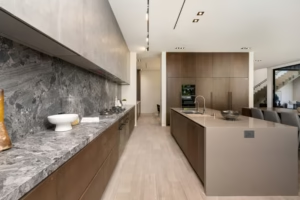
Kitchen designers who specify White Fantasy Granite regularly note it pairs well with both warm wood cabinets and cool-toned cabinetry. That flexibility is part of why it shows up across such a wide range of styles, from farmhouse to modern minimalist.
Cost Considerations
Pricing for this stone runs higher than standard granite, typically landing between $50 and $100 per square foot installed, depending on grade, slab availability, and your region. Premium grade slabs with minimal fill lines sit at the top of that range. Commercial grade slabs with more natural fractures cost less but need more careful fabrication.
Installation adds to the material price, usually running $10 to $40 per square foot depending on edge profile, sink or cooktop cutouts, and how many seams the layout requires. A kitchen with a large island plus an L-shaped counter run costs more in labor than a small galley kitchen, even with the same square footage of stone.
Shipping affects price too, since a lot of supply comes from overseas quarries. Buying from a local fabricator who already stocks slabs domestically usually costs less than special-ordering a slab shipped straight from a quarry.
Budget an extra 10 to 15 percent above your first quote for sealing, edge upgrades, or unexpected cutout work once installation starts. Stone projects rarely land at the exact first estimate.
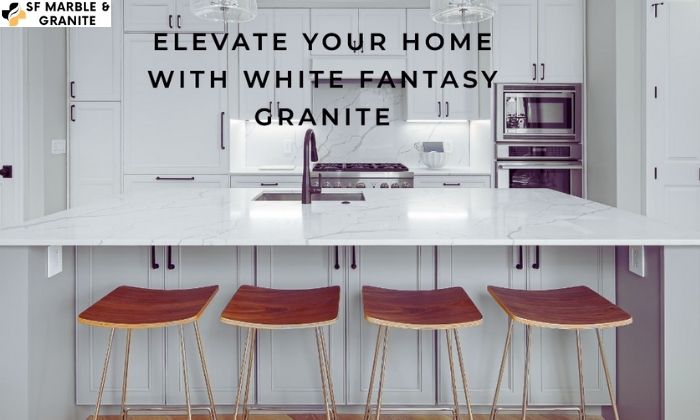
White Fantasy Granite vs. Other Natural Stones
White Fantasy Granite distinguishes itself from other natural stones by offering a unique combination of durability and aesthetics. Unlike some softer stones, it is highly resistant to heat and scratches, making it a practical choice for countertops and high-traffic areas. Its intricate veining patterns add an elegant touch, setting it apart from the uniformity of other materials. When compared to marble and quartz, these Granite stands out for its durability, stain resistance, and the one-of-a-kind beauty it brings to interior and exterior design projects.
Where to Source White Fantasy Granite
To obtain these Granite for your project, local suppliers, distributors, and specialized showrooms are reliable sources. These establishments often carry a diverse selection of White Granite options, allowing you to explore various patterns and finishes. Additionally, well-established brands like SF Marble and Granite offer a reputable source for this exquisite stone, ensuring both quality and a wide range of choices.
Conclusion
White Fantasy Granite, offered by SF Marble and Granite, stands as a natural wonder that effortlessly infuses elegance into any living space. Its exceptional visual appeal, robust durability, and adaptability make it the preferred choice for a multitude of applications. Whether you’re contemplating it for your kitchen countertops or a grand design project, White Granite seamlessly combines beauty and functionality. For inquiries, please contact us to explore our range.
FAQs
Is White Fantasy Granite expensive?
It sits in the mid-range price bracket among natural stone countertops, more than entry-level granite but less than rare marbles or premium quartzites. Final cost depends on slab grade, thickness, and edge detailing, plus local labor rates, so a written quote from a fabricator gives the most accurate number for your project.
Does White Fantasy Granite need sealing?
Yes, it needs sealing roughly once a year to protect against stains, since it’s a porous natural stone. Skipping this step lets oil, wine, and citrus juice soak in over time, which can leave permanent discoloration that no amount of scrubbing will fix.
Is it heat resistant?
Yes, it handles direct heat from pots and pans without warping, scorching, or discoloring. This makes it a strong pick for anyone who cooks often and doesn’t want to worry about trivets every single time a pan comes off the stove.
How does it compare to quartz?
Quartz needs no sealing and resists stains slightly better, but it can’t take direct heat the way this granite can. If your kitchen sees heavy cooking, granite generally holds up better long term, though quartz wins on low maintenance.
Where can I get it installed?
If you’re in Massachusetts and ready to move forward, SF Marble and Granite handles Granite Countertop Installation in Lowell, from slab selection through fabrication and final fit. Local experience with this specific stone means fewer surprises during install, from seam placement to edge finishing.