Picking a countertop or floor material feels harder than it should. Marble looks stunning in every showroom photo, but the price tag and the upkeep list make most homeowners pause before they sign off on it. If you’ve landed on the term “engineered marble” while comparing options, you’re in the right spot.
Engineered marble is a man-made stone surface built from crushed natural marble bound together with resin, usually polyester, under heat and pressure. That’s the short answer to what is engineered marble in one line. Below, we’ll cover how it’s made, how it stacks up against natural marble, cultured marble and quartz, where it works best in a home, and what to expect once it’s installed.
How Italian Carrara Marble Looks?
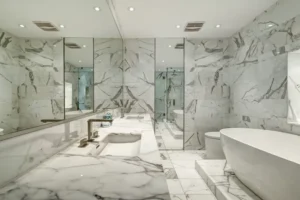
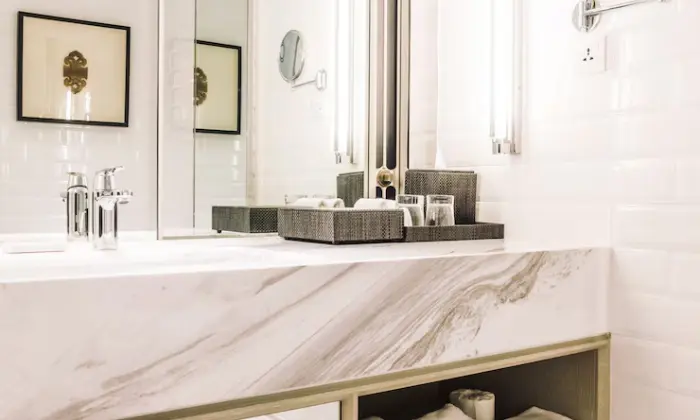
Italian Carrara Marble features a soft white or blue-gray background with delicate, feather-like gray veining that flows across each slab. Its pattern is softer and more diffused compared to bold, high-contrast stones.
The background color rarely shows pure, blinding white. Instead, it leans toward a subtle off-white or misty pearl tint. The veins run in thin, linear paths or light clouds, ranging from charcoal to silver-gray.
Unlike Calacatta marble which features stark white fields with heavy, thick veins Carrara offers a uniform appearance. This subtle pattern makes it easier to match tile seams across large surfaces.
Data from natural stone trade organizations shows that soft gray metamorphic stones like Carrara reflect roughly 60% to 70% of ambient light, helping brighten low-lit interior rooms without causing harsh glare.
Italian Carrara Marble Tiles
Italian Carrara Marble tiles are pre-cut natural stone slabs used for flooring, shower walls, backsplashes, and accessible bathroom remodels. They come in polished and honed finishes in standard field sizes or mosaic layouts.
When setting up a safe, low-maintenance living area for an aging relative or family member recovering from surgery, tile selection requires balancing slip resistance with ease of cleaning.
Tile Formats and Applications
Subway Tiles ($3 \times 6$ or $4 \times 12$ inches): Ideal for kitchen backsplashes and low-maintenance tub surrounds.
Hexagon & Basketweave Mosaics: Excellent for curbless, zero-threshold shower floors. The frequent grout lines provide essential traction underfoot, reducing slip hazards for seniors or individuals using mobility aids.
Large Format Tiles ($12 \times 24$ inches): Minimize grout lines on floor surfaces, creating a smooth, level plane that accommodates walkers or wheelchairs comfortably.
Italian Carrara Marble Vanity Top
An Italian Carrara Marble vanity top is a pre-fabricated or custom-cut stone slab fitted over a bathroom vanity, featuring sink cutouts and integrated backsplashes. It delivers a hygienic, durable surface that holds up well to daily personal care routines.
For caregivers managing daily care routines, bathroom countertops must withstand frequent cleaning while maintaining a clean, comfortable environment. A vanity top made from this stone provides a cool-to-the-touch, sturdy surface that holds up to daily use.
Choosing the Right Surface Details
Integrated Sink Options: Undermount porcelain sinks paired with Carrara tops eliminate surface lips, allowing caregivers to wipe water, soap, or spilled medications directly into the basin without catching debris on edges.
Eased or Rounded Edges: Selecting an “eased,” “half-bullnose,” or “waterfall” edge profile eliminates sharp corners, providing a safer surface in homes where balance or mobility might be a concern.
Sealant Protection: Applying a penetrating impregnating sealer once or twice a year keeps moisture, oils, and hygiene products from penetrating the stone pores.
Genuine Carrara Marble Made in Italy
Genuine Italian Carrara Marble originates exclusively from quarries in the Apuan Alps of Northern Italy, carrying distinct mineral purity and authentic geological origin. Lower-cost alternatives imported from other regions often lack the structural integrity and consistent color profile of authentic Italian stone.
Due to its global reputation, non-Italian white marbles are sometimes labeled as “Carrara-style” or “Carrara White.” Understanding origin markers ensures you purchase authentic material.
| Feature | Authentic Italian Carrara | Regional Alternatives / Imitations |
| Origin | Apuan Alps, Tuscany, Italy | Various international regions |
| Base Color | Soft white, light pearl-gray | Chalky white or yellow-tinted |
| Veining | Soft, feathery, natural linear flows | Blotchy, artificial, or mud-like pools |
| Density | Dense calcite matrix; highly durable | Variable; prone to flaking or micro-cracking |
| Authenticity | Accompanied by quarry origin documentation | Generic “white marble” labelling |
To verify authenticity, ask your supplier or fabricator for the stone’s Certificate of Origin and specific quarry designation (such as Gioia, Fantiscritti, or Colonnata quarries).
How Much Does Italian Carrara Marble Cost?
Italian Carrara marble typically runs between $40 and $100 per square foot installed, depending on the grade, slab thickness, and finish. Tiles sit on the lower end of that range, while premium slabs with minimal veining variation and higher-grade stone push toward the top.
Price depends heavily on grade. Lower grades have more visible fillers, fractures, or resin repairs, while higher grades are cut from more consistent sections of the quarry block. Fabrication and edge details, like a mitered or ogee edge, also add to the total beyond the raw material cost.
Maintenance and Care for Long-Term Durability
Maintaining natural stone surfaces requires straightforward care. Because marble is composed of calcium carbonate, it reacts with acidic substances like vinegar, lemon juice, or harsh chemical cleaners, which can dull the finish through a process known as etching.
Daily Wiping: Clean surfaces using a soft microfiber cloth with warm water and a few drops of pH-neutral stone cleaner or mild dish soap.
Immediate Spill Prevention: Wipe away liquids—especially citric juices, coffee, or dark liquids—promptly to prevent surface staining.
Routine Sealing: Test your stone’s seal annually by dropping a few beads of water on the surface. If the water absorbs within 10 minutes rather than standing in tight beads, reapply a breathable stone sealer.
Genuine Carrara Marble Made in Italy
Genuine Carrara Marble is prized for its beauty, quality, and historical significance. Quarried from the Carrara region in Tuscany, Italy, this marble has been used in iconic sculptures and buildings for centuries. However, due to its popularity, imitations and lesser-quality marbles are often marketed as Carrara marble. To ensure you are purchasing authentic Carrara marble, it’s essential to know how to identify it.
inal Thoughts
Choosing between marble, granite, or quartz usually comes down to how you use the space and how much upkeep you’re willing to do. Carrara marble rewards a little extra care with a look that granite and engineered stone can’t quite copy. If your project leans toward a harder-wearing surface instead, our team also handles Granite Countertop Installation in Lowell, from measuring to final polish.
At SF Marble and Granite, we work with both natural stone types and can walk you through which one actually fits your kitchen or bathroom, not just which one looks best in a showroom. Contact us to talk through your project and get a quote based on your space, not a generic price sheet.
FAQs
Is Carrara marble expensive?
It sits in the mid to upper range of natural stone pricing, generally $40 to $100 per square foot installed. Tile is more affordable than slab, and grade affects price more than most people expect.
Is Carrara marble good for kitchen countertops?
It can work well, but it needs more maintenance than granite or quartz due to its softer, porous surface. Many homeowners use it for islands or backsplashes and pair it with a harder material for the main prep area.
How do I know if Carrara marble is real?
Ask for documentation tracing the stone to an Italian quarry, and look closely at the veining. Genuine stone has irregular, natural veining, while imitations often show a repeating pattern.
What’s the difference between Carrara and Calacatta marble?
Carrara has softer, thinner grey veining on a light grey to white background. Calacatta has bolder, thicker veins and a brighter white base, and it typically costs more.
Does Carrara marble stain easily?
It’s more prone to staining and etching than granite or quartz because it’s more porous. Regular sealing and quick cleanup of spills keep this risk low.