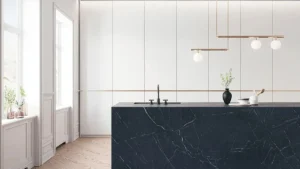
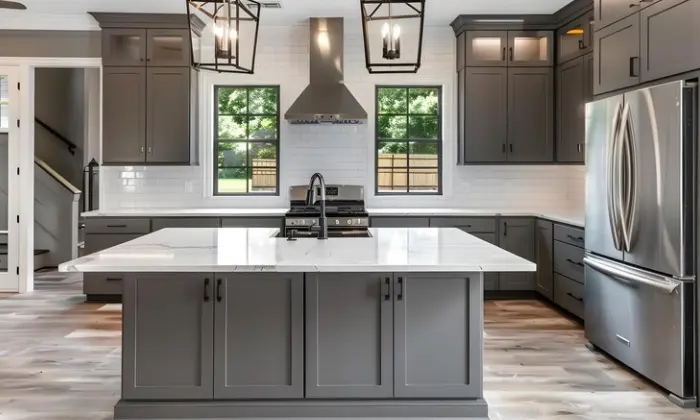
If you’re considering pairing neutral cabinetry with dark surfaces to create a balanced, homey kitchen environment, you’re on the right track. Combining grey kitchen cabinets with black countertops gives your space a grounded, stable feel while keeping maintenance straightforward for busy households.
This pairing delivers a grounded, timeless contrast that fits traditional homes, modern layouts, and accessible floor plans alike. In this guide, we’ll walk through shade selections, material options, installation essentials, and complementary design choices to help you create a functional, welcoming kitchen.
Benefits of Choosing Grey Kitchen Cabinets with Black Countertops
Pairing light or dark grey cabinets with deep black surfaces provides several practical advantages for daily living:
-
Forgiving Surfaces: Darker stone surfaces like honed granite or quartz naturally disguise minor spills, water spots, and daily wear better than light surfaces.
-
Visual Stability: Dark lower surfaces create an anchor point, making open-plan kitchens feel structured and easy to navigate.
-
Versatile Palette: Grey serves as an ideal middle ground. It pairs easily with warm wood tones, brushed nickel, or high-contrast white walls.
-
Timeless Appeal: Unlike bright accent colors, grey and black remain visually comfortable and stylish for decades.
Choosing the Right Shade of Grey Cabinets
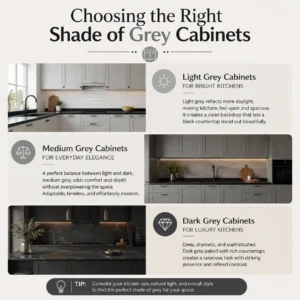
The specific tone of grey you select sets the overall mood and light level in your kitchen.
Light Grey Tones
Light grey cabinets reflect ambient light efficiently, making smaller kitchens feel open and airy. Shades like dove grey or soft ash offer a gentle contrast against black stone without feeling stark.
Medium Grey Tones
Medium greys, such as slate or pewter, deliver a steady balance. They hide scuffs from mobility equipment or high foot traffic while remaining bright enough for easy visibility during meal preparation.
Dark Charcoal Greys
Charcoal and graphite cabinets create a rich, cohesive look when paired with dark countertops. To prevent the room from feeling dim, ensure adequate task lighting under the cabinets and overhead.
Popular Black Countertop Materials
Not all black countertops perform the same way, and the material you pick affects both the look and the upkeep.
Black granite is the most common choice for gray cabinets with black countertops because it’s durable, heat resistant, and available in a range of finishes from polished to leathered. It handles daily cooking without much fuss, and it holds up well over decades with basic sealing.
Black quartz gives you a more consistent, uniform look since it’s engineered rather than a product of nature. It doesn’t need sealing, which some homeowners prefer, and it resists staining better than most natural stone.
Soapstone is a quieter option that develops a soft patina over time. It’s softer than granite or quartz, so it can scratch, but many homeowners like that lived-in look as it ages.
Black Marble Countertops
Characteristics
Found in nature, black marble stands out due to striking veins – often white or golden – that trace across its surface. A distinct design marks every piece, offering visual depth without repetition.
Advantages
Other stones may resist damage better, yet none carry quite the same presence along with history. Uniqueness combined with timeless appeal makes it stand apart from most alternatives.
Style
Black marble beside grey cabinets brings a sense of quiet elegance. In high-end kitchen spaces, attention often lands on bold textures instead of color alone.
Pairing Other Popular Countertops and Cabinet Colors
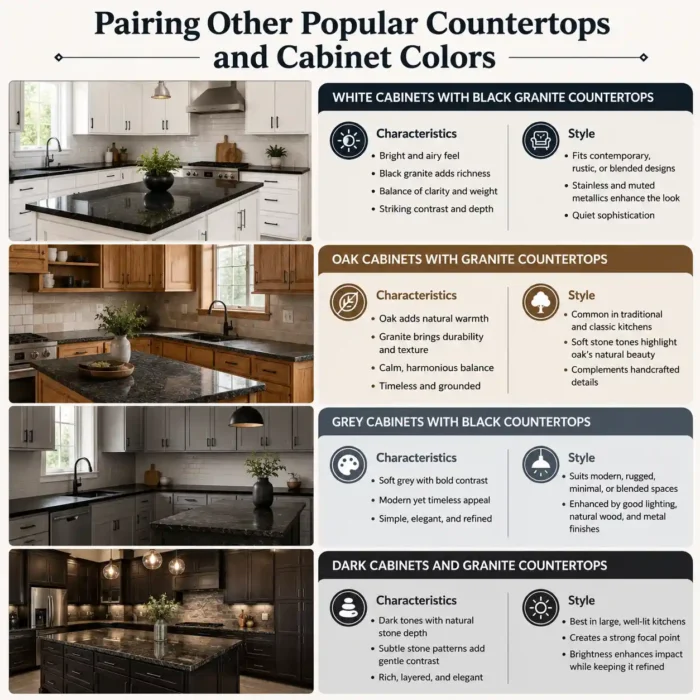
Black isn’t the only countertop that works with grey cabinets, and grey isn’t your only cabinet option if you’re still deciding.
White quartz with movement or veining softens the look of dark gray cabinets with black countertops elsewhere in the kitchen, such as on an island, while keeping most of the room lighter. This is a common approach when homeowners want contrast without an entirely dark kitchen.
Black cabinets with grey countertops flip the formula and give you a more dramatic base with a lighter, quieter top surface. It’s a strong look, but it works best in kitchens with good natural light or well-planned task lighting.
Two-tone kitchens, grey lower cabinets with a lighter upper cabinet or a contrasting island, are also common right now. This lets you use black countertops on the island as a focal point while keeping the rest of the room lighter and easier to live with.
Installing Grey Kitchen Cabinets with Black Countertops
Installation is where a good design plan can go wrong if it’s rushed. Cabinets need to be level and secured properly before a stone countertop template is even taken, since stone doesn’t flex to fit an uneven base the way laminate might.
Templating for the countertop usually happens after cabinets are installed, not before. This step measures your exact kitchen layout so the slab is cut to fit, rather than forcing your cabinets to match a pre-cut piece.
Countertop Installation
Prepare the Cabinet Surface
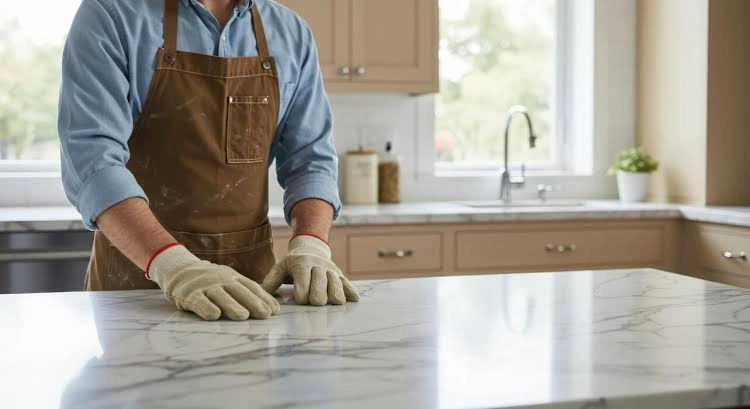
Start by confirming the upper surfaces of lower cabinets show no debris, sit flat, and remain stable. Where irregularities appear, adjustments must happen before countertop installation in Lowell so excess pressure does not build. Finish only when support meets strict alignment standards to ensure a secure, long-lasting countertop installation.
Cut and Position the Countertop
Stone surfaces require careful measurement before shaping. Accuracy matters most when forming spaces for sinks, defining edges, or joining corners. Expert handling during production helps maintain consistency throughout these details.
Secure and Seal the Countertop
Depending on the type of countertop, choose an appropriate bonding method. With natural stone, protection begins when sealing every open surface as directed by the maker. Moisture resistance improves once sealant covers all cut sides fully.
Finishing Touches
Install the Backsplash
Following attachment of the countertop, position the backsplash to shield the wall surface while contributing to visual cohesion. With careful selection, the backsplash intensifies the distinction between cabinetry and worktop areas.
Apply Caulk and Sealant
Where surfaces join – countertop to wall, sink, or cabinet – sealing matters. Water stays out when gaps are closed correctly. A tidy result follows naturally from careful attention at each seam.
Install Fixtures and Hardware
Installation of the sink begins the last phase, followed by the faucet fitting into position. Cabinet handles appear next, then drawer pulls take their place nearby. Lighting fixtures mount afterward, while leftover accessories settle in around them.
Final Thoughts on Grey Kitchen Cabinets with Black Countertops
Grey kitchen cabinets with black countertops create a striking and modern look that’s both stylish and practical. This combination offers a sophisticated contrast that enhances the overall aesthetic of your kitchen, while also being easy to maintain. It’s a versatile choice that fits various design styles and adds a touch of elegance to any space. For high-quality materials and expert installation, SF Marble and Granite is here to help. Contact us to transform your kitchen with premium countertops and professional service.
FAQs
1. Are grey kitchen cabinets with black countertops a good combination?
Yes. Grey kitchen cabinets and black countertops create a modern, timeless look that suits many home styles. The grey softens the boldness of black, resulting in a balanced and elegant kitchen design.
2. What shade of grey cabinets looks best with black countertops?
Light grey, medium grey, and charcoal grey all pair well with black countertops. Light grey creates contrast and brightens the space, while darker greys offer a rich, sophisticated appearance with a seamless finish.
3. Which countertop materials work best for black kitchen countertops?
Popular choices include black granite, quartz, quartzite, marble, and soapstone. Each material offers different benefits in terms of durability, maintenance, and appearance, allowing homeowners to choose based on their needs and budget.
4. What backsplash goes well with grey cabinets and black countertops?
White subway tile, marble backsplashes, light grey tiles, and patterned mosaic designs complement this color combination. A lighter backsplash helps brighten the kitchen while adding visual contrast.
5. How can I make a kitchen with grey cabinets and black countertops feel brighter?
Use white or neutral walls, under-cabinet lighting, large windows, reflective backsplashes, and warm metallic hardware like brass or brushed nickel. These elements help create a brighter, more open, and inviting kitchen.