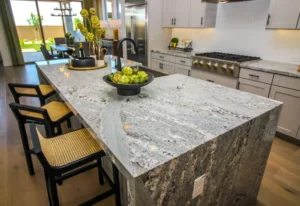
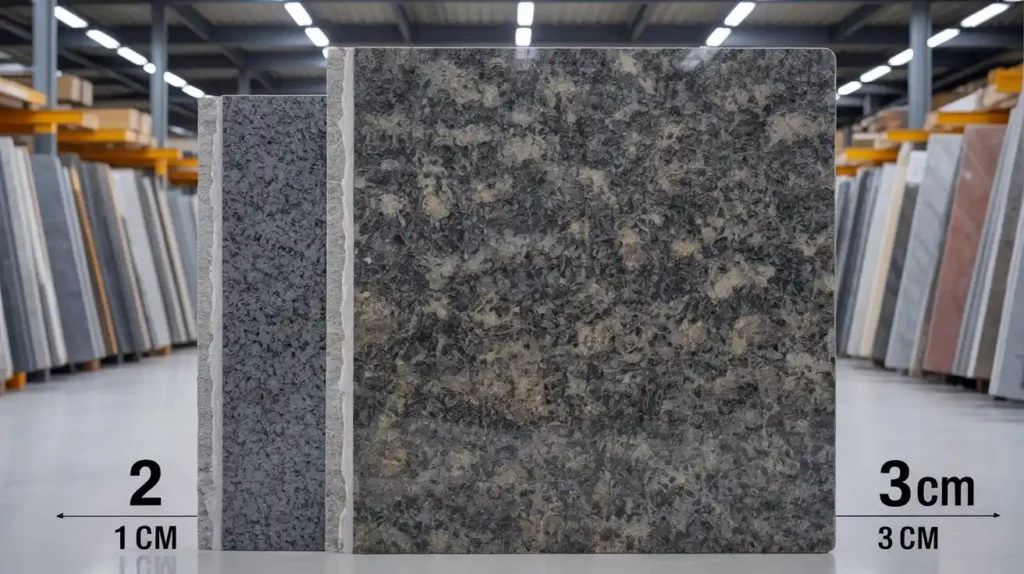
Here’s the short answer: granite countertop weight per square foot is roughly 18 to 20 lbs at 3/4 inch thick (the most common residential thickness). At 1.25 inches thick, that number climbs to around 28 to 30 lbs per square foot.
Let’s put that into real numbers:
- Small kitchen (25–30 sq ft of counter space): 450–600 lbs
- Average kitchen (35–50 sq ft): 630–1,000 lbs
- Large kitchen (60+ sq ft): 1,080 lbs or more
And that’s just the countertops. Factor in an island, and you’re adding another 200–400 lbs.
How much does a granite countertop weigh for a standard 10-foot run? A 10 ft x 2 ft slab at 3/4-inch thick is about 20 sq ft. At 18–20 lbs per sq ft, that’s 360–400 lbs for a single run alone.
Why Does the Weight of Granite Matter?
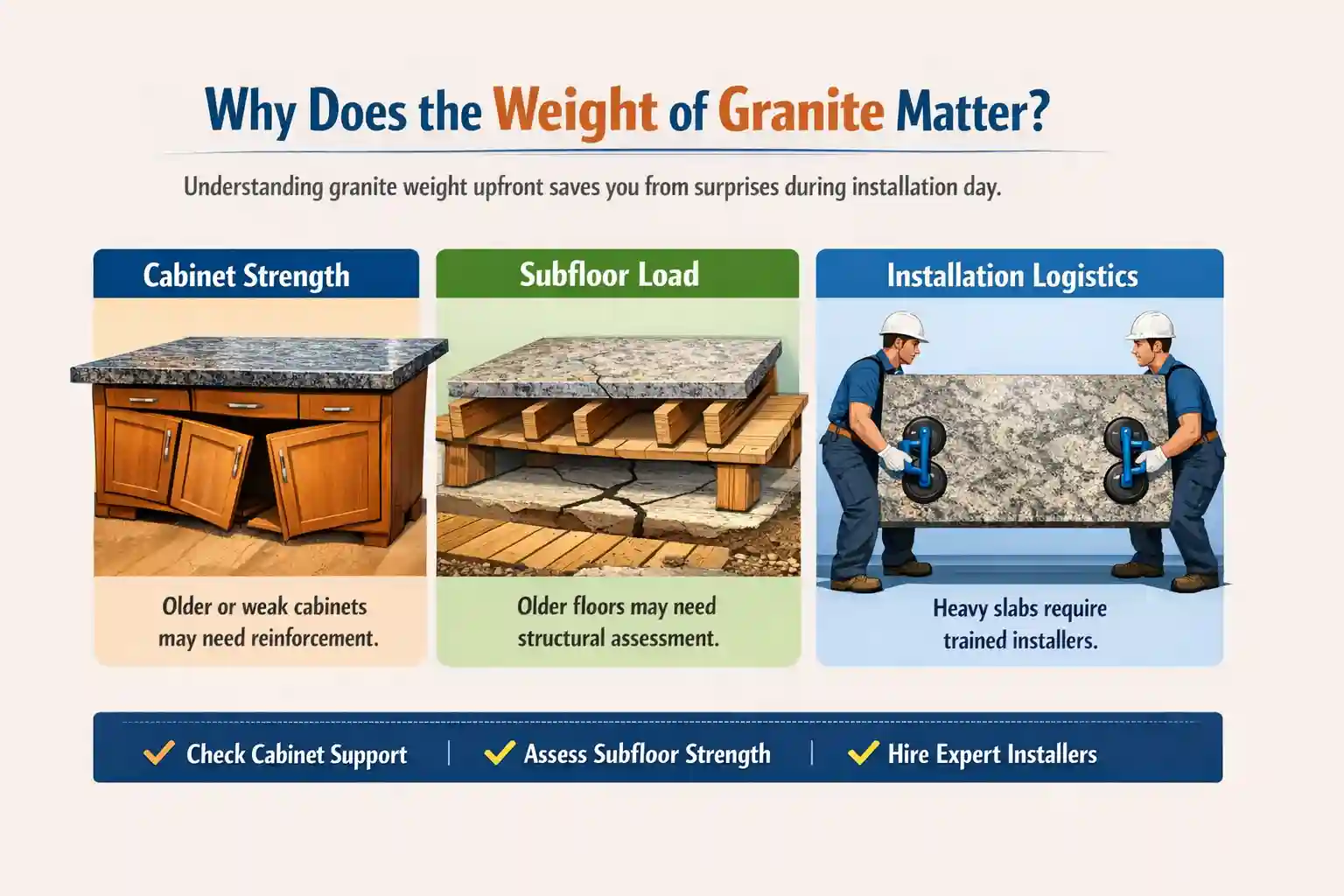
Weight matters for three big reasons:
- Cabinet strength. Not all cabinets are built to handle 1,000+ pounds sitting on top of them. Standard builder-grade cabinets can handle it, but older or custom cabinets may need reinforcement first.
- Subfloor load. In older homes, floors and subfloors were not designed with stone countertops in mind. A structural assessment helps avoid problems down the line.
- Installation logistics. You cannot carry a large granite slab by hand. It requires trained installers, specialized tools, and careful handling to avoid cracking the stone or injuring someone.
Understanding granite weight upfront saves you from surprises during installation day.
Factors That Affect Granite Countertop Weight
Not all granite weighs the same. Here’s what changes the number:
1. Thickness
The biggest factor. The two most common thicknesses are:
- 3/4 inch (2 cm): About 18–20 lbs per sq ft. Used in most residential kitchens.
- 1.25 inches (3 cm): About 28–30 lbs per sq ft. Stronger and preferred for large spans without support underneath.
Some commercial projects use even thicker slabs, pushing weight higher still.
2. Granite Density
The weight of granite per cubic foot is typically 160 to 170 lbs. But different granite varieties have slightly different densities. Darker granites like Absolute Black tend to be denser than lighter ones like White Ice or Kashmir White.
3. Slab Size
Bigger slabs mean more weight. A full slab from the quarry is typically 9 ft x 5 ft. That’s 45 sq ft, or roughly 800–900 lbs for a 3/4-inch piece.
4. Edge Profiles
Fancy edge profiles like ogee or full bullnose add material. That adds weight. A simple eased edge keeps the weight closer to baseline estimates.
5. Cutouts
Sink cutouts, cooktop holes, and faucet openings actually remove material, reducing weight slightly. But they also weaken the slab structurally, requiring extra care during handling.
Granite vs. Other Countertop Materials (Weight Comparison)
Want to know how granite stacks up? Here’s a direct comparison of granite weight per sq ft against other popular options:
| Material | Weight Per Sq Ft |
| Granite (3/4″) | 18–20 lbs |
| Marble (3/4″) | 16–18 lbs |
| Quartz (3/4″) | 20–25 lbs |
| Quartzite (3/4″) | 18–22 lbs |
| Laminate | 1–3 lbs |
| Butcher Block | 8–12 lbs |
| Concrete | 18–25 lbs |
| Porcelain (slim) | 8–12 lbs |
Granite is heavier than laminate and wood by a big margin. It’s comparable to quartz and quartzite. Marble is slightly lighter but still in the same ballpark.
The key takeaway: granite is a heavyweight material, and any alternative that’s close to it in weight will have similar structural demands.
Do Granite Countertops Require Extra Support?
In most cases, no extra support is needed if your base cabinets are solid and in good shape. Standard kitchen cabinets are typically rated to hold 300–400 lbs per linear foot, which is well above what granite demands.
But there are situations where additional support helps:
- Overhangs longer than 10–12 inches: Granite can crack under its own weight if it’s cantilevered too far. Corbels or hidden steel brackets fix this.
- Spans over 36 inches without an undermount: For long, unsupported runs, 3 cm (1.25″) granite is a better choice than 2 cm.
- Older or custom cabinetry: If the cabinets feel soft, flex, or are more than 20 years old, have a contractor check them first.
- Islands with seating overhangs: Bar overhangs of 12+ inches need corbels. For 15–18 inch overhangs, stainless steel brackets work better.
When in doubt, ask your installer to check the cabinet condition before the slab goes on.
How Granite Weight Impacts Installation
How much does granite countertop weigh matters most on installation day. Here’s why it shapes the whole process:
Crew Size
A 200 lb slab needs at least two strong people. A full 800–900 lb slab needs three to four professionals with suction cups and lift tools. No serious installer shows up solo with a granite slab.
Transportation
Slabs are never laid flat in a truck they crack from their own weight. They’re transported vertically on A-frames or padded racks. This is non-negotiable.
Template Accuracy
Because granite is heavy and hard to move once set, templating has to be exact. Most installers use digital templating tools today. Small mistakes in measurement mean expensive re-cuts or gaps.
Seams
On long countertop runs, slabs are cut and joined with seams. Heavy slabs need proper alignment and epoxy bonding to stay stable over time. Weight distribution across seams matters for durability.
Plumbing and Appliances
All plumbing connections and appliance rough-ins need to be done before the slab is set. Moving a granite countertop after it’s placed is not easy. That’s the beauty of working with experienced professionals who plan ahead.
You may also read: How to Treat Granite Countertops
What Is the Standard Granite Slab Size and Weight?
If you’re ordering directly from a supplier, here’s what to expect:
- Full slab: Approximately 9 ft x 5 ft (45 sq ft), weighing 810–900 lbs at 3/4 inch thick.
- Half slab: About 4.5 ft x 5 ft, weighing 405–450 lbs.
- Prefabricated sections: Common in big-box stores. Usually 8 ft strips, weighing 144–160 lbs each.
For most kitchens, you’ll need one to two full slabs depending on layout and square footage.
Why Granite Countertops Are Worth the Weight
Yes, granite is heavy. Yes, it needs proper installation. But here’s why people keep choosing it:
Durability. Granite is one of the hardest natural stones on earth, rating 6–7 on the Mohs hardness scale. It resists scratches from everyday cooking better than most surfaces.
Heat resistance. You can set a hot pan on granite without it warping, cracking, or burning. Try that with laminate.
Unique appearance. No two granite slabs are identical. The natural variation gives your kitchen a look that can’t be mass-produced.
Long-term value. Granite adds to a home’s resale value. Buyers notice it. Real estate agents mention it. It pays back over time.
Low maintenance. A sealed granite surface resists stains well. Annual resealing keeps it protected for years.
The weight is not a drawback. It’s proof of the density that makes granite so tough.
Why Choose Us for Granite Countertops in Lowell, MA
At SF Marble & Granite, we’ve been handling granite countertops in the Lowell area for years. We know the weight. We know the logistics. And we know how to make the entire process smooth from first measurement to final polish.
Our team handles:
- Professional templating using digital tools for precise fits
- In-house fabrication so your slab isn’t outsourced and delayed
- Experienced installation crews trained to handle heavy slabs safely
- Cabinet inspection before any stone goes in, to protect your investment
- Full slab selection across dozens of granite colors and patterns
If you’re planning a kitchen remodel or bathroom upgrade in the Lowell, MA area, check out our Granite Countertop Installation Lowell MA service page to see what we offer and request a free estimate.
We work with homeowners, contractors, and designers. Whether it’s a small bathroom vanity or a large open-plan kitchen, we treat every project the same: with care, precision, and real expertise.
Final Thoughts
Granite is one of the most popular countertop choices for good reason. It looks great, lasts for decades, and handles daily kitchen abuse without flinching. But its weight is something you need to plan for, not just guess about.
How heavy are granite countertops? Heavy enough to demand proper planning, the right cabinets, and experienced installers. But not so heavy that it’s a problem when you hire the right team.
If you’re in Lowell, MA or the surrounding area, SF Marble & Granite is ready to help you get this right from day one.
FAQs
How heavy are granite countertops per square foot?
At the standard 3/4-inch thickness, granite weighs 18 to 20 lbs per square foot. At 1.25 inches, the weight goes up to 28 to 30 lbs per square foot.
How much does a granite countertop weigh for a full kitchen?
A typical kitchen with 35 to 50 square feet of counter space will have granite weighing between 630 and 1,000 lbs total, depending on thickness and slab density.
Can my cabinets hold the weight of granite countertops?
Most standard kitchen cabinets can. They’re typically rated for 300 to 400 lbs per linear foot. However, older or weaker cabinets should be inspected before installation.
What is the weight of granite per cubic foot?
Granite weighs approximately 160 to 170 lbs per cubic foot. This varies slightly depending on the specific granite variety and its mineral composition.
Do granite countertops need extra structural support?
Not usually. But overhangs longer than 10 to 12 inches, unsupported spans over 36 inches, and older cabinetry may need added support like corbels or steel brackets.
How does granite compare to quartz in weight?
They’re close. Granite weighs 18 to 20 lbs per sq ft, while quartz runs 20 to 25 lbs per sq ft at the same thickness. Both require the same level of cabinet preparation.
Is granite too heavy for a second-floor kitchen?
Rarely. Most home structures can handle granite’s weight without modification. For older homes or large installations, a contractor can verify the floor’s load capacity.