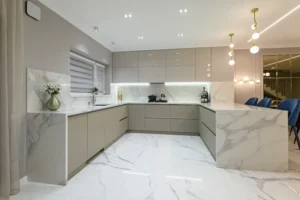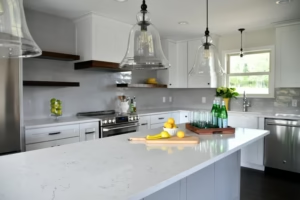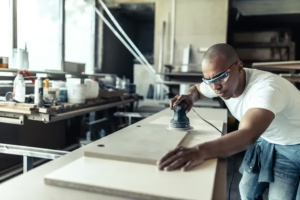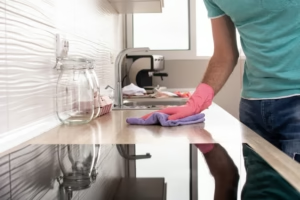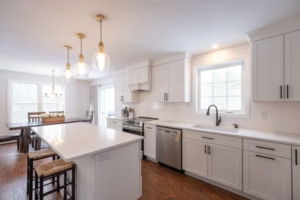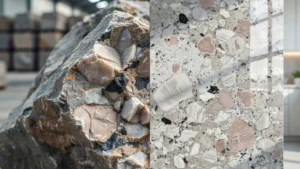
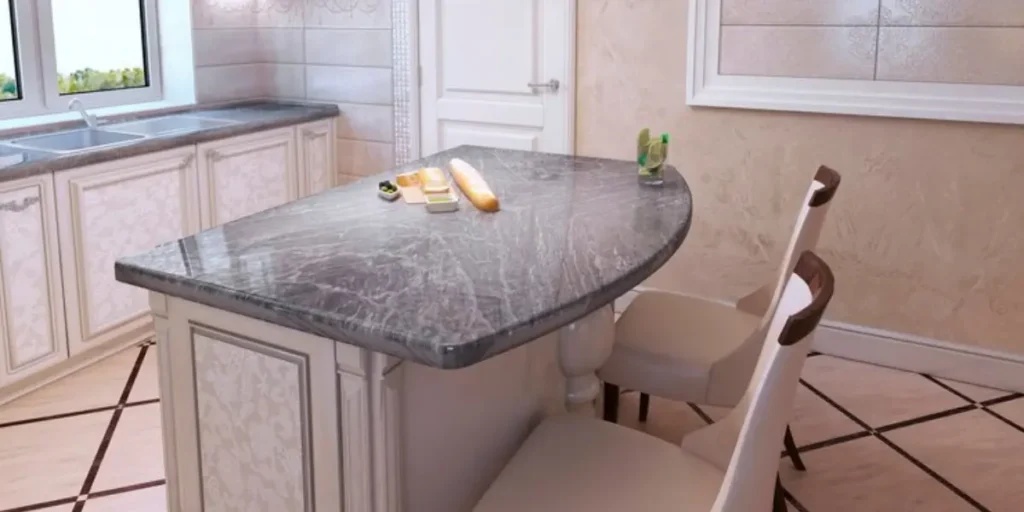
Taj Mahal Quartzite is a natural stone slab quarried in Brazil, known for a soft ivory or beige base with wispy gold, taupe, and gray veining. It’s classified by many geologists as a dolomitic marble rather than true quartzite, but the trade name has stuck, and it’s sold and installed the same way.
That naming debate matters less than you’d think. What matters is performance. Real quartzite forms when sandstone gets compressed under heat and pressure over millions of years, and it typically lands around a 7 on the Mohs hardness scale, harder than granite. Whether it’s technically quartzite or a hard marble, it’s sold as a premium slab that resists scratching and etching better than standard marble does. It’s quarried, cut, and finished in large slabs, then shipped to fabricators who cut it to fit your kitchen or bath.
What is Taj Mahal Quartzite?
Taj Mahal Quartzite is a naturally occurring metamorphic stone quarried in Brazil, formed when quartz-rich sandstone undergoes intense heat and pressure deep within the Earth. The resulting material features a soft white or cream background accented by gentle gold, taupe, and bronze veining.
Many homeowners mistake this material for marble or soft dolomite due to its delicate movement and light tones. However, it is an entirely natural quartz-based stone that performs very differently in daily use.
Geologically, it scores approximately 7 on the Mohs hardness scale. This rating makes it significantly harder than standard marble (which rates around 3 to 5) and slightly denser than typical granite. The intense geological compression welds individual quartz grains together, giving the slab a tight structure.
| Material Property | Taj Mahal Surface Stone | Standard Marble | Typical Granite |
| Origin | Quagga quarries, Brazil | Varied worldwide | Varied worldwide |
| Mohs Hardness | ~7 (Very High) | 3 to 5 (Soft) | 6 to 6.5 (Medium-High) |
| Acid Etching Risk | Extremely Low | High (ethes easily) | Low |
| Primary Visual | Warm cream with gold veins | Cool white with gray veins | Flecked, granular pattern |
When evaluating slabs, verify that your stone supplier provides authentic Brazilian material. True quartzite will not etch when exposed to household acids like lemon juice or vinegar.
Is Taj Mahal Quartzite Outdated?
No, this stone is not outdated. Warm, neutral stones with soft veining have replaced the stark white and cool gray countertops that dominated the 2010s, and Taj Mahal fits squarely into that change. Its ivory and gold tones read as classic rather than trendy, which is why designers keep specifying it in new builds.
Kitchen trends move fast, but neutral natural stone tends to age well because it doesn’t chase a single decade’s color palette. Bold patterned quartz and stark white marble-look surfaces can start to feel dated within five to ten years. A warm, veined stone like this one doesn’t carry that risk the same way, because it echoes materials that have been used in high-end homes for generations.
Is Taj Mahal Quartzite Expensive?
Yes, Taj Mahal Quartzite is generally positioned in the premium natural-stone category. Material prices can vary widely based on slab grade, size, veining, thickness, finish, availability, fabrication, transportation, and installation, so a local quote is more useful than a single national price.
Current published industry listings show a wide range. One supplier guide lists retail material around $65 to $120 or more per square foot, while another product sheet lists a premium polished 3 cm slab at $130 per square foot before labor and installation. These figures are examples, not a fixed market price.
Your final project price can include more than the slab itself. Ask whether the estimate includes:
- Slab material
- Template and measurements
- Cutting and fabrication
- Edge profile
- Sink cutouts
- Cooktop cutouts
- Sealing
What Color is Taj Mahal Quartzite?
Taj Mahal Quartzite features a warm off-white or creamy beige base interwoven with subtle veins of gold, amber, light brown, and pale grey. Overall, its color palette feels soft, warm, and luminous rather than stark or cool.
Color distribution varies from slab to slab because it is a natural material. Some slabs lean heavily toward warm parchment tones with pronounced caramel veining. Others feature a paler background with whisper-thin, silvery-grey striations.
When inspecting slabs at a stone yard:
Check Under Real Lighting: View the slab under both warm artificial light and natural daylight.
Examine the Movement: Look at how the veining flows across the entire sheet to plan seams effectively.
Inspect the Background: Ensure the underlying base color matches your surrounding cabinetry and flooring samples.
What Color Cabinets Work Best with Taj Mahal Quartzite Countertops?
Quartzite countertops from Taj Mahal complement a range of cabinet hues rather elegantly. Here are a few well-known choices:
Popular Combinations:
- White Cabinets: Brightens the space for a timeless look.
- Beige Tones: Enhances the warmth of the veining for a cohesive design.
- Dark Cabinets: Creates dramatic contrast for a sophisticated feel.
- Gray Cabinets: Achieves a modern and balanced aesthetic.
Tip: Visit our showroom in Lowell to see these combinations in person.
Popular Types of Taj Mahal Quartzite Finishes
Most fabricators offer three finish options, and each changes how the stone reads in a room.
- Polished: The most common choice. It has a glossy surface that reflects light and makes the veining pop.
- Honed: A matte finish with a soft, velvety texture. It hides fingerprints and water spots better than polished, and it suits a modern farmhouse look.
- Leathered: A textured finish that adds slight depth and a rustic feel. It’s less common but works well for a statement island.
Polished is the safest choice for resale value, since it’s what most buyers expect. Honed and leathered work best when you want your kitchen to feel intentional and a little less predictable.
Think about how each finish behaves day to day, not just how it looks in a photo. Polished shows water spots faster around a busy sink. Honed hides those spots but shows oil marks more readily. Leathered is forgiving with both, which is why it works well on a high-use island.
Incorporating Taj Mahal Quartzite into Your Kitchen Design
There are several ways you might include it into your kitchen design to produce an amazing and coherent effect. Here are some design concepts meant to motivate you:
Applications:
- Countertops: The focal point of any kitchen design.
- Backsplashes: Seamless extension of countertops for a cohesive look.
- Accent Walls: Adds elegance to open-concept kitchens.
- Kitchen Islands: Makes your island the centerpiece of the room.
- Flooring: Durable option for high-traffic areas.
Local Trend: Many Lowell homeowners are opting for full-height quartzite backsplashes to create a seamless design flow.
Maintenance Tips for Taj Mahal Quartzite Countertops
Your Quartzite counters will remain gorgeous for years to come with proper upkeep. These guidelines help you to preserve this beautiful natural stone:
How to Keep It Looking New:
- Regular Cleaning: Use mild soap and water; avoid abrasive cleaners.
- Sealing: Apply sealant annually to prevent stains (consult SF Marble & Granite experts).
- Avoiding Damage: Always use cutting boards; avoid direct impacts or heavy loads.
- Heat Protection: Use trivets or hot pads despite its heat resistance.
- Preventing Stains: Clean spills immediately; protect surfaces from acidic substances like lemon juice or vinegar.
Taj Mahal Quartzite vs Marble, Granite, and Quartz
Every homeowner comparing stone eventually asks how this one stacks up against the usual suspects.
| Feature | Taj Mahal Quartzite | Marble | Granite | Engineered Quartz |
|---|---|---|---|---|
| Composition | Natural stone (dolomitic marble/quartzite) | Natural stone | Natural stone | ~90% ground quartz, resin binder |
| Hardness | High, resists scratching | Softer, etches easily | High | High, but resin can burn |
| Heat resistance | Strong | Weak | Strong | Moderate, can scorch |
| Maintenance | Seal every 1–2 years | Seal often, avoid acids | Seal every 1–2 years | No sealing needed |
| Look | Marble-like veining | Classic veining | Speckled, less veining | Consistent, printed pattern |
| Price per sq ft installed | $90–$220 | $80–$250 | $50–$100 | $50–$120 |
Marble looks similar but etches the moment lemon juice or wine touches it. Granite is durable but rarely gives you that soft, flowing vein pattern. Engineered quartz is low maintenance, but it’s manufactured, so it lacks the one-of-a-kind movement you get from a natural slab.
If your priority is a completely worry-free surface and you cook with a lot of acidic ingredients, engineered quartz still wins on pure convenience. If your priority is the closest look to real marble without the upkeep, this stone is the more practical pick between the two natural options.
Conclusion
Taj Mahal Quartzite is an exceptional choice for homeowners looking to combine beauty and functionality in their kitchens or bathrooms in Lowell, MA. Its timeless appeal, low maintenance requirements, and versatility make it an investment worth considering.
Ready to transform your space? Visit SF Marble & Granite Inc.’s showroom at 755 Dutton St., Lowell, MA 01854 today! Contact us at sfmarbleandgranite@gmail.com or call 978-459-5823 to schedule your free consultation.
FAQs
Is Taj Mahal Quartzite really quartzite?
Geologically, it’s often classified as a dolomitic marble, not true quartzite. The trade name stuck because of how it looks and performs, and it’s sold, cut, and cared for the same way quartzite is.
Where does Taj Mahal Quartzite come from?
It’s quarried in Brazil, despite the name referencing the monument in India. The name comes from the visual resemblance to the marble inlay work on the actual Taj Mahal.
Does Taj Mahal Quartzite need to be sealed?
Yes. Sealing once or twice a year keeps it resistant to stains from wine, oil, and coffee. Skipping this step increases the risk of staining over time, even though the stone itself is dense.
Can Taj Mahal Quartzite be used in a bathroom?
Yes, it works well for vanities, tub surrounds, and shower walls. Its resistance to moisture and staining makes it a solid choice outside the kitchen too.
How does it compare to Super White Quartzite?
Both share a similar white and gray palette, but Taj Mahal tends to run warmer with gold and beige veining, while Super White leans cooler and grayer.