When you search for Calacatta Gold Marble, you’re looking to understand why this natural stone commands such high prestige, how much it costs, where it works best in a home, and how to maintain its pristine appearance over time. In short, you want clear facts on its unique aesthetic, practical application, pricing dynamics, and maintenance requirements to decide if it’s the right surface for your project.
This comprehensive guide breaks down everything you need to know about this iconic Italian stone, from slab selection and design applications to care protocols and cost factors.
Features of Calacatta Gold Marble
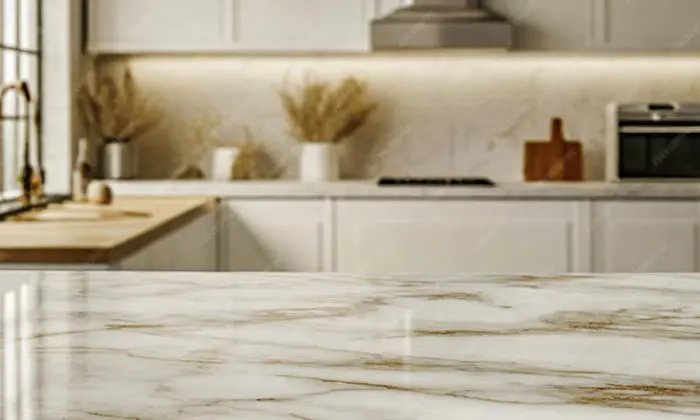
Calacatta Gold Marble is a high-end calcite stone quarried exclusively in the Apuan Alps near Carrara, Italy. Unlike common marbles, it features a warm, bright white background rather than a cool or muddy grey base.
Its defining characteristic is its bold, dramatically thick veining. The pattern flows across the slab in sweeping ribbons of soft warm grey, taupe, and rich honey-gold.
Because it’s a natural metamorphic rock, no two slabs are identical. The distribution of gold veining varies from subtle accents to striking linear streaks, making every installation unique.
Porosity: High (calcite-based natural stone)
Density: ~2.7 g/cm³
Mohs Hardness: 3 to 4
Absorption Rate: ~0.15% to 0.20% by weight
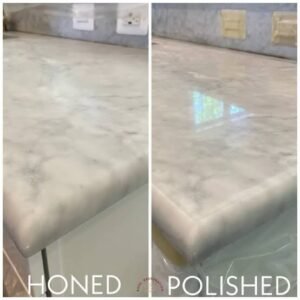
Finish Options: Polished (high sheen) or Honed (matte, velvety finish)
The Allure of Calacatta Gold Marble
Why is Calacatta Gold Marble so highly sought after? The secret lies in its rare balance of warm and cool tones.
Most white marbles lean heavily toward cool blue-grey undertones. Calacatta Gold breaks this pattern by infusing warm gold and copper highlights into a crisp white backdrop. This warmth allows the stone to bridge different design elements, pairing smoothly with both cool silver fixtures and warm brass or wood tones.
Furthermore, it carries historical prestige. Italian quarries produce limited quantities of this high-grade stone annually, keeping supply tight and demand high.
Applications of Calacatta Gold Marble
Due to its soft calcite structure, this material is best suited for low-to-medium traffic indoor spaces or places where luxury aesthetic is the primary goal.
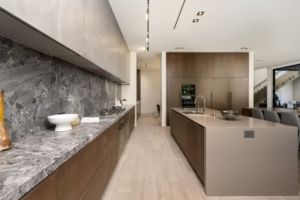
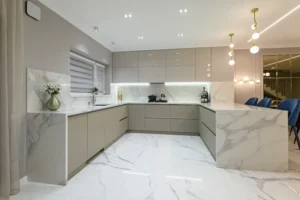
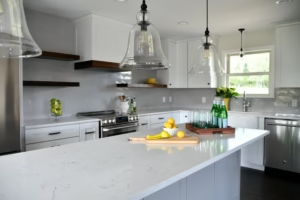
Kitchen Countertops and Waterfalls: Creates a focal point, especially when edge-matched or mitered down the sides of an island.
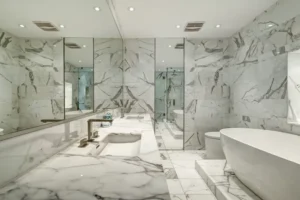
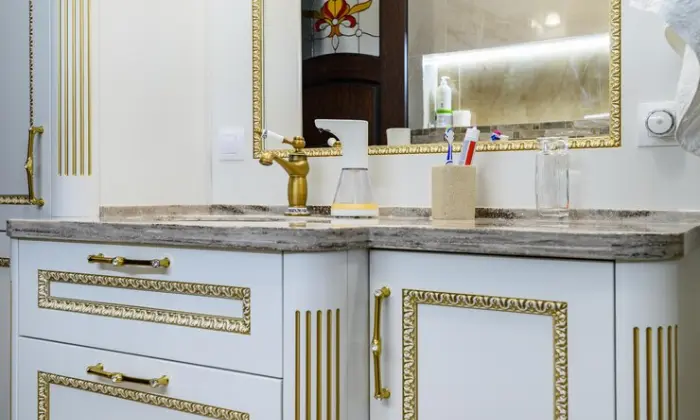
Bathroom Vanities and Shower Walls: Transforms master suites into spa-like retreats.
Fireplace Surrounds: Handles radiant heat smoothly while offering a dramatic visual centerpiece.
Statement Backsplashes: Offers continuous visual interest, particularly in full-slab backsplash installations.
Comparing Calacatta to Other Marbles
It’s easy to confuse Italian white marbles, but subtle details separate them clearly.
| Feature | Calacatta Gold Marble | Carrara Marble | Statuario Marble |
| Background Color | Warm, pure bright white | Soft greyish-white | Luminous cold white |
| Vein Style | Bold, dramatic ribbons | Soft, feathery, overall gray | Heavy, dark charcoal gray |
| Gold Accents | Present (Honey/Amber tones) | None | None |
| Rarity & Price | Very High ($100–$300+/sq. ft.) | Moderate ($40–$80/sq. ft.) | High ($80–$220/sq. ft.) |
Carrara features soft, diffuse gray veining across a darker grey background. Statuario offers dramatic charcoal-grey veining over a bright white field, but lacks any gold highlights entirely.
Unique Design in Homes
Integrating this stone into residential spaces requires thoughtful coordination with surrounding finishes.
Because the stone contains both warm gold and neutral grey, it pairs effortlessly with mixed metal hardware. For instance, brushed brass faucets highlight the golden veins, while polished nickel or dark iron accents ground the grey undertones.
Cabinetry selections also play a big role. Dark navy, forest green, or charcoal cabinets create a striking contrast against the bright white ground. Alternatively, warm white or natural oak cabinets create a seamless, organic aesthetic.
Care and Maintenance
Cleaning Tips
Calacatta Gold Marble requires regular cleaning to maintain its beauty. Use a pH-neutral cleaner and a soft cloth to wipe down surfaces. Avoid acidic or abrasive cleaners that can etch the marble.
Sealing
Sealing it helps protect it from stains and etching. It’s recommended to seal and install marble countertops and tiles at least once a year. Ensure you use a high-quality sealant designed for natural stone.
Preventing Damage
To prevent damage, always use coasters under glasses and trivets under hot pots. Avoid cutting directly on the marble surface to prevent scratches. Regularly inspect your marble for any signs of wear and address them promptly.
Understanding Calacatta Gold Marble Slab Price
How much does Calacatta Gold Marble cost? Calacatta Gold Marble slab prices generally range between $100 and $300 per square foot for the material alone, with total installed costs ranging from $180 to $400+ per square foot depending on slab grade, thickness, and fabrication complexity.
Key Price Factors
Slab Grade: Slabs classified as “Extra White” featuring pure backgrounds and intense gold veining cost significantly more than lower grades with muted or greyish fields.
Thickness: Standard 2cm slabs cost less than 3cm slabs, though 3cm offers greater structural integrity for countertop overhangs.
Book-Matching: Joining two consecutive slabs so their veining creates a mirror image requires high precision and increases material waste, driving up costs.
Fabrication and Installation: Cutting, edging, sink cutouts, and specialized transport add $40 to $100+ per square foot.
Real-Life Examples and Inspirations
Luxurious Kitchens
In high-end kitchens, it is often used for both countertops and backsplashes, creating a cohesive and elegant look. Pairing it with custom cabinetry and high-end appliances completes the luxurious feel.
Spa-Like Bathrooms
It can transform a bathroom into a spa-like retreat. Use it for countertops, shower walls, and floors to create a serene and sophisticated space. The natural stone’s beauty will make your bathroom feel like a five-star resort.
Elegant Living Spaces
In living spaces, it can be used for fireplace surrounds, coffee tables, and accent walls. Its dramatic veining adds a touch of elegance and sophistication to any room.
Essential Care and Maintenance Protocols
Because marble consists of calcium carbonate, it’s vulnerable to acid etching and staining from vinegar, lemon juice, wine, or tomato sauce.
To keep your investment looking fresh:
Seal Regularly: Apply an impregnating stone sealer upon installation and reapply every 6 to 12 months.
Clean Daily: Use pH-neutral stone cleaners or warm water with a mild microfiber cloth. Never use bleach, ammonia, or acidic bathroom cleaners.
Wipe Spills Instantly: Clean up coffee, wine, and citrus juice immediately to prevent etching or permanent discoloration.
Use Protection: Always place trivets under hot pans and use cutting boards to prevent scratches.
Local Fabrication & Service Guidance
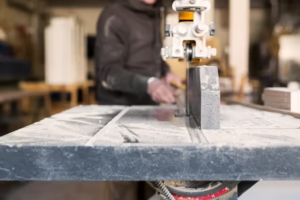
When investing in high-grade natural stone, precision fabrication and professional installation are essential to prevent cracking or vein misalignment. If you’re located in New England, expert local fabricators offer precise custom edge profiles, digital vein-matching, and seamless installation services.
For reliable local countertop service, explore options like Granite Countertop Installation in Lowell provided by team at SF Marble and Granite to ensure your stone is handled with professional care.
Contact us today to speak with a stone specialist or schedule a slab showroom consultation.
FAQs
Is Calacatta Gold Marble real marble?
Yes, it’s genuine natural marble quarried in the Carrara region of Tuscany, Italy. It is not a synthetic material or engineered quartz product, though quartz manufacturers frequently create faux prints inspired by its pattern.
Does Calacatta Gold stain easily?
Because it’s a natural porous stone, it can stain if left unsealed. However, regular sealing with a penetrating sealer significantly reduces absorption, giving you time to wipe up spills before they penetrate the surface.
What is the difference between honed and polished finishes?
A polished finish is smooth and reflective, bringing out the depth of colors, but it shows acid etch marks more clearly under direct light. A honed finish is matte and satin-like, hiding scratches and etching much better, though it remains slightly more susceptible to oil stains if unsealed.