
You just spotted a new chip in your granite counter and now you are looking at it wondering just how bad the damage truly is. It’s normal to get that sinking feeling. A small chip might not appear to be a big deal, but you should take care of it before dust and grease get into the crack and make it more difficult to repair.
The short answer is yes, you can repair a chip in a granite countertop yourself in less than an hour with a two-part epoxy resin colored to match your stone. Prep the area, mix the epoxy, fill the chip, cure it, sand it, then polish it flush with the surface. Below, I will walk you through exactly how to mend a chip on a granite countertop, the tools you will need, and how to know when the work is better left to a pro.
Why Granite Chips Happen
Granite is tough, but its strength doesn’t make it immune to impact damage. Chips usually happen at vulnerable points rather than in the middle of a well-supported countertop.
Common causes include:
Dropped Heavy Objects
A cast-iron pan, heavy pot, or other hard object can damage granite when it strikes the surface or edge with enough force.
Impact on the Edge
Countertop edges are more exposed than flat surfaces. The thinner part of the granite around an edge can chip when hit by cookware, dishes, or other hard items.
Pressure Near Cutouts
The stone around a sink or cooktop cutout is narrower and can be more vulnerable. Excessive force, poor support, or movement in the countertop may lead to damage.
Existing Weaknesses
Some chips begin with an existing fissure, natural mineral separation, or previous damage. A small impact may then remove material from an already vulnerable area.
Tools and Materials You’ll Need
Start by collecting every tool you’ll need before diving into fixes. When each piece sits nearby, the work flows easier plus mistakes drop away. A full setup means fewer trips across the room – less chaos, more progress.
Essential Repair Materials
Most times, fixing a granite countertop works best with a dual-component epoxy made just for stone. Acetone or rubbing alcohol comes into play for prep work. Painter’s tape holds edges clean during application.
Most everyday glues aren’t built for stone – they can yellow or crack when used near heat or water. A proper stone repair kit sticks better, lasts longer, and finishes smoother.
Optional Items for Better Results
Most countertops carry a mix of tones and flecks. When fixing chips, matching that look matters. Pigments adjust the epoxy’s shade so it blends right in. Because natural stone rarely looks uniform, customizing the filler helps hide the fix. A touch of color goes far toward making repairs disappear.
A rough patch could need light sanding after the glue dries, just enough to blend it into nearby areas. The surface takes on a softer feel when worked gently by hand
Step-by-Step Guide: How to Fix a Chip on Granite Countertop

Step-by-Step Guide: How to Fix a Chip on Granite Countertop
Step 1: Clean the Damaged Area
Start with a clean, dry chip.
Remove crumbs, dust, grease, and loose stone fragments. Use a small amount of acetone or another suitable cleaner recommended for your repair product, then allow the area to dry fully.
Don’t flood the chip with liquid. The repair material needs good contact with the stone.
A simple rule helps here: clean stone repairs better than contaminated stone.
Step 2: Remove Loose Granite Carefully
Inspect the damaged area under good lighting. Remove only pieces that are already loose.
Don’t dig aggressively into the chip. You don’t want to enlarge the damage while trying to clean it.
A toothpick, soft brush, or gentle stream of compressed air can help remove fine debris. Wear eye protection when blowing out a chip.
If the damaged piece is still attached, don’t automatically pull it off. A professional may be able to stabilize and reattach a larger fragment.
Step 3: Protect the Surrounding Surface
Apply painter’s tape around the repair area, leaving the chip exposed.
This creates a clean boundary and helps prevent excess epoxy from spreading across the countertop. It also makes cleanup easier.
Use tape carefully around decorative edges. You don’t want tape to interfere with the shape you’re trying to rebuild.
Step 4: Match the Granite Color
This step can be the difference between a competent repair and an obvious one.
Start by mixing a little bit of color pigment. Granite isn’t necessarily solid colored. It might be black, gray, white, brown, gold or mineral flecks.
If the chip is bigger or more conspicuous start with a base color that is the dominating color of the damage. After the patch has cured, you can sometimes add tiny mineral-like details with a fine tool and appropriate pigment.
Don’t try to match the whole countertop. Match the immediate area of the chip
A minor repair near a dark material may be colored differently from another repair only a few inches away. It is normal.
Step 5: Mix the Repair Resin
Follow the manufacturer’s instructions exactly.
Many stone repair products use two components that must be mixed in a specific ratio. Guessing the amount can cause curing problems.
Mix slowly and thoroughly. Avoid whipping excess air into the material.
If you need a pigment, add it gradually. A repair that’s slightly too dark may stand out just as much as one that’s too light.
You can read about: How To Fix Tiles With Tile Adhesive
Tips for a Better Repair (From Real Experience)
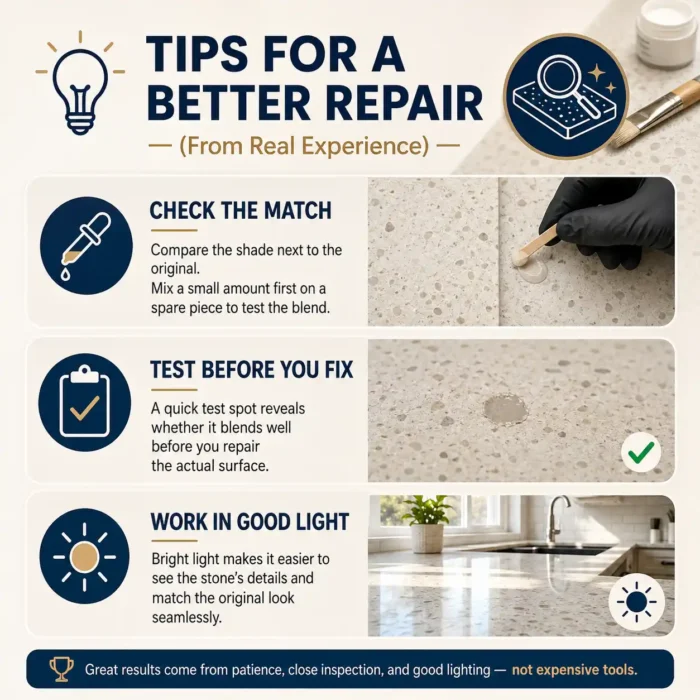
Small repairs reward patience. The biggest mistakes often happen when someone tries to finish the job too quickly.
Test the Color Before Filling the Chip
If possible, test your mixed color on a disposable surface and allow a small sample to cure. The wet color may look different after hardening.
Use Good Lighting
Daylight can help you judge the color, but bright indoor lighting is also useful. Move your viewpoint around the countertop.
A repair can look perfect from directly above but stand out when viewed from the side.
Work on One Small Chip at a Time
Don’t mix a large batch of epoxy for several small repairs unless the product’s working time allows it. Once the material starts curing, you lose control of its consistency.
Photograph the Damage First
Take close-up photos before starting.
This gives you a reference if the chip changes during cleaning. It can also help a professional understand the original damage if you later need assistance.
When to Call a Professional Instead
Call a professional when the chip is larger than a quarter, sits near a sink cutout, or when you want a repair that’s genuinely invisible rather than just close. DIY kits handle small, shallow chips well, but structural areas and large gaps carry more risk of a botched fix.
A few situations point clearly toward hiring help. If the chip exposes a seam or a layer beneath the surface stone, that’s a sign of deeper damage than a simple fill can address. If you’ve already attempted a repair chip in granite countertop project and the patch looks cloudy, uneven, or discolored, a professional can often remove and redo it with the right tools.
Professional stone countertop repair technicians use diamond polishing pads and color-matching systems that go beyond what’s available in a retail kit. For a counter you’ll look at every day, that difference in finish is often worth the cost.
Tips to Prevent Future Chips
A little routine care goes a long way toward avoiding a repeat trip through this whole process.
- Use cutting boards and trivets instead of setting pots, pans, or knives directly on the stone
- Avoid dropping heavy items like mixers or cast iron near the counter’s edge
- Keep weight off thin overhangs, especially at the sink or island edge
- Reseal your granite once a year to keep the surface resistant to chipping and staining
- Move appliances carefully rather than sliding them across the counter
- Check the seal each spring by dropping a few beads of water on the surface; if it soaks in within a few minutes instead of beading up, it’s time to reseal
None of these steps take much time, but they add up. A countertop that’s sealed regularly and treated with a bit of care at the edges will go years without needing another repair chip in granite countertop project.
Contact SF Marble and Granite for Expert Assistance
Some chip repairs are genuinely straightforward DIY projects. Others whether because of size, location, stone type, or complexity benefit significantly from professional expertise.
SF Marble & Granite provides expert Granite Countertop Repair in Lowell, MA for chips, cracks, surface damage, and full stone restoration. Our repair technicians work with all granite varieties, quartzite, marble, and engineered stone using professional-grade materials and techniques that produce results significantly better than consumer repair kits on complex or large damage.
We also assess repairs honestly. If a chip is small and genuinely DIY-appropriate, we will tell you that. If it requires professional work to look right, we will explain why and give you a clear, fair estimate before any work begins.
Conclusion
A small crack in stone could look bad at first glance, but handling repairs alone saves money without hurting how the kitchen appears. Because epoxy handles minor flaws effectively, wiping the area before adding the solution matters – spread it evenly so edges fade into place. After drying slowly, the results merge close to the original surfaces.
Most folks overlook tiny cracks until they spread. Yet a quick patch changes how clean the surface feels. With careful touches, flaws sink back into the slab like old memories. One shaky move risks more damage. Smooth results come not from speed but from pauses between steps. What counts isn’t duration, it’s how much thought goes into each step. Outcomes improve if energy lines up with focus.
Contact us for professional granite repair that restores your countertop to its original condition.
Frequently Asked Questions (FAQs)
How to fix a chip on a granite countertop without a professional repair kit?
For very small surface nicks less than 1/4 inch clear super glue applied with a toothpick and allowed to cure can provide a temporary fill. Sand flush with fine sandpaper and buff. This is a temporary solution only. For anything larger or more visible, a proper two-part stone epoxy kit produces a significantly more durable and visually acceptable result.
How long does granite countertop repair epoxy last?
A properly executed granite chip repair using quality two-part epoxy lasts many years often the lifetime of the countertop. The repair is typically harder than the surrounding stone once fully cured. Failure occurs when the area was not cleaned properly before application, the epoxy was not mixed correctly, or the repair was stressed before full cure.
Can you repair granite countertop chips yourself if the stone is dark colored?
Yes but color matching is harder on dark granite like Absolute Black or Blue Pearl because the contrast between the epoxy fill and the stone is more visible. Use the darkest tinting pigment available in your repair kit and test the color match on cardboard in natural light before applying to the countertop. Many homeowners with very dark granite prefer professional repair specifically because of the color matching challenge.
Is stone countertop repair different for quartzite versus granite?
Quartzite is harder and more crystalline than granite, which makes it more resistant to chipping but also slightly more difficult to repair when chips do occur. The repair process is similar clean, fill with epoxy, cure, sand, and polish but quartzite’s hardness requires more patience during the sanding and polishing stages to achieve a smooth, flush finish.
How do I know if my granite chip needs professional repair or can be done DIY?
DIY is appropriate for chips under 1/2 inch in diameter with no structural cracking extending from the chip. Professional repair is the better choice for chips larger than 1/2 inch, chips with radiating cracks, chips in highly visible central locations, or any repair on premium stone where a perfect match is important. When in doubt, a professional assessment is free at most stone shops and takes the guesswork out of the decision.